
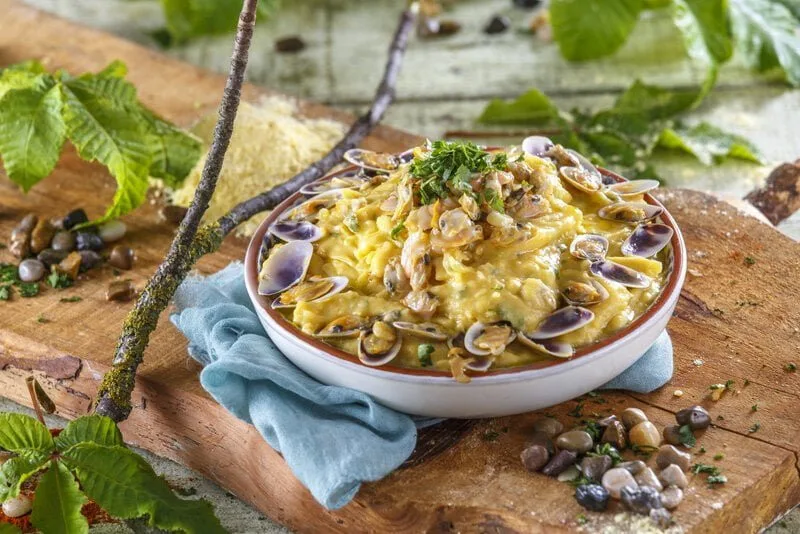
Xarém com Conquilhas — sometimes spelled "Xerém" — is one of the most beloved traditional dishes of the eastern Algarve and a direct culinary legacy of the region's 500-year Moorish past. The word "xarém" itself derives from the Arabic "Zerem," meaning "grain porridge," and points to the dish's origins in the Andalusi-period agricultural communities that dominated southern Portugal between the 8th and 13th centuries.
The dish is deceptively simple. Cornmeal is slowly cooked with water, lard (or olive oil in lighter modern versions), salt, and torn fresh bread until it becomes a creamy, golden polenta — the "papas de milho" that form the base. Onto this, small wedge clams called conquilhas (Donax trunculus, locally harvested along the Algarve's barrier beaches) are added with strips of smoked bacon, garlic, and a generous handful of fresh coriander. The conquilhas open in the heat, releasing their briny juices into the corn — the result is a rich, complex, deeply savoury dish that locals describe as the eastern Algarve's defining comfort food. Xarém com conquilhas was a finalist in Portugal's "7 Wonders of Portuguese Gastronomy" contest.
Regional variations matter. In Olhão the dish is most commonly made with ameijoas (Venus clams) rather than conquilhas; in Tavira the strict conquilhas version dominates; and curiously, in Faro the same combination of corn and ameijoas is sometimes called by a wonderful local name — "baile de roda com castanholas" ("round dance with castanets"). Other regional variations swap the shellfish for sardines, prawns, or even peas.
The dish can be served as a starter (smaller portion, almost a soup) or — more typically — as a generous main, with thick slices of bread on the side to soak up the broth. It pairs naturally with chilled Algarve white wine. Best eaten at family-run tascas in the historic fishing towns of Faro, Olhão and Tavira, where the recipes have been passed down across generations.
⭐ Imprescindible:
Xarém com conquilhas served as a generous main with fresh bread, paired with white Algarve wine
Platos típicos
- Xarém com conquilhas (the classic — wedge clams)
- Xarém com ameijoas (Olhão and Faro variant — Venus clams)
- "Baile de roda com castanholas" (Faro local name for ameijoas version)
- Xarém com camarão (with shrimp)
- Xarém com sardinhas (with sardines — heartier rural version)
- Xarém com ervilhas (with peas — vegetarian-friendly)
Destacados
- Finalist in Portugal's 7 Wonders of Portuguese Gastronomy
- Moorish heritage dish — name derives from Arabic "Zerem" (grain porridge)
- Made with cornmeal polenta, conquilhas (wedge clams), bacon, coriander and bread
- Regional variations: Olhão (ameijoas), Tavira (conquilhas), Faro ("baile de roda")
- Best in family-run tascas across the eastern Algarve fishing towns
- Served as a starter (smaller bowl) or generous main course
- Pairs naturally with chilled Algarve white wine
- Conquilhas are sustainably harvested along Algarve barrier beaches
Opciones dietéticas
✓ Pescatarian (with shellfish)
✓ Contains gluten (bread torn into the base — confirm to omit if needed)
✓ Contains dairy-free (no milk used)
✓ Contains shellfish allergens (conquilhas/ameijoas/camarão)
✓ Vegetarian version possible on request (with peas, no bacon)
✓ Naturally gluten-free if served without bread
Preguntas frecuentes
What's the difference between xarém, ameijoas and conquilhas?
Xarém is the corn-polenta base (cornmeal slow-cooked with water, lard and bread) — it's the foundation of the dish. Conquilhas (Donax trunculus) are small, sweet, wedge-shaped clams unique to the Algarve coast, harvested by hand at low tide on the barrier beaches. Ameijoas are slightly larger Venus clams (Ruditapes decussatus or similar species), more widely available across Portugal. Both shellfish work brilliantly with the corn base; the choice tends to be a regional one.
Where's the best place to try it in Faro?
Faro has several traditional tascas that serve excellent xarém. Look for restaurants in the Old Town and around the marina with the dish prominently on the menu — it's often listed as "Xarém com conquilhas" or "Xerém de conquilhas". The "baile de roda com castanholas" version (with ameijoas) is a Faro speciality and worth asking about. Adjacent towns Olhão and Tavira (15–35 min away) also have famous specialist restaurants for the dish.
What does it taste like?
Imagine a savoury, slightly grainy yellow polenta — comforting and creamy — flavoured intensely with garlic, smoked bacon, fresh coriander and the briny essence of just-opened clams. The texture is somewhere between risotto and porridge. It's not a delicate dish; it's deeply nourishing, rich and salty, with the kind of layered savouriness that comes from a long-developed peasant tradition. Best eaten with thick slices of bread to soak up the juices and a glass of cold white wine.
Is it suitable for tourists who don't usually eat shellfish?
Some versions can be made with sardines, prawns, peas, or even just bacon and bread — ask the restaurant if you prefer to avoid clams. The corn base alone is naturally gluten-free (if no bread is added), vegetarian-friendly, and deeply satisfying. Many Algarvian restaurants will prepare a vegetarian xarém on request, with peas, fresh herbs and good olive oil instead of shellfish.
How is it usually eaten — as a starter or main?
Both, depending on portion size and venue. A "dose" (full portion) is a generous main course, often shared between two people. A "meia dose" (half portion) works as a starter for one. Most traditional restaurants serve the dish in a clay bowl with the clams visible on top and the bread served separately. Allow 30+ minutes from order to plate — the dish is cooked slowly and to order in proper tascas.