
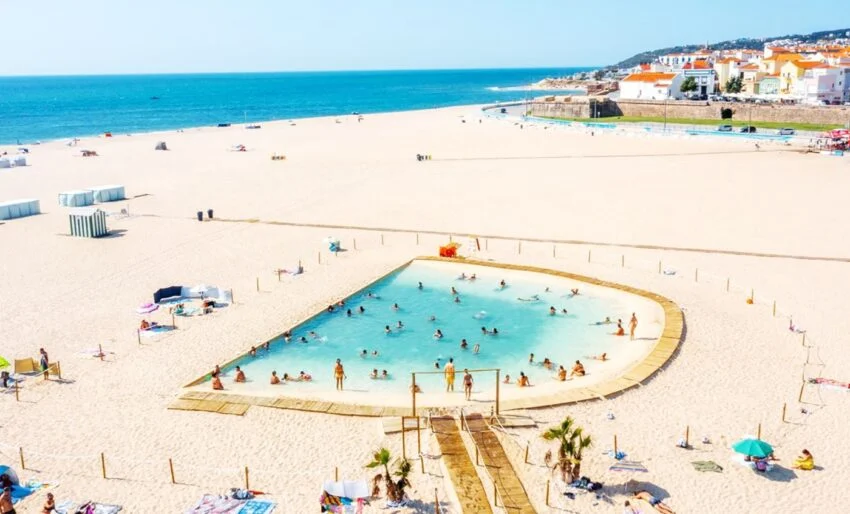
Praia da Claridade is the longest urban beach in Portugal and, by many counts, one of the widest in Europe. The sand stretches roughly one kilometre along the Atlantic, from the northern jetty to the cliffs below Buarcos, and reaches close to 650 metres in width at the broadest point — wide enough to host volleyball, football and beach rugby courts without crowding the bathers.
The beach takes its name from the brightness of the light reflected on the sand, a quality first noted by the 19th-century journalist Augusto Pinto, who named it the "Queen of the Beaches of Portugal". Figueira da Foz rose to prominence as a seaside resort during that century, attracting wealthy families from across Portugal, the Alentejo and Spain. The wooden boardwalks, the rows of colourful cabanas and the iconic Nivea ball remain part of the visual identity that the city has preserved for over a century.
The bathing season runs from 1 June to 21 September, with lifeguards on duty and Blue Flag certification for most stretches of the coast. The Atlantic water remains cool year-round, which is why the municipality installed a heated saltwater pool directly on the sand at the Claridade — water at 29°C, free of charge, in 30-minute slots, first-come first-served. A second pool operates at the adjacent Praia de Buarcos.
The beach hosts the RFM Somnii sunset festival in early July, one of the largest electronic music gatherings in the Iberian Peninsula.
Destacados
- One of the widest urban beaches in Continental Europe — roughly 650 m of sand at low tide
- Nicknamed the "Queen of Portuguese Beaches" since the 19th century
- Heated saltwater pool on the sand, 29°C, free public access
- Blue Flag certification, lifeguards from 1 June to 21 September
- Hosts RFM Somnii, one of Iberia's largest sunset music festivals
History & context
Originally a simple stretch of dune behind the Mondego mouth, the beach was transformed into a fashionable resort during the second half of the 19th century, when wealthy families from Portugal, the Alentejo and Spain began spending the summer in Figueira da Foz. The writer Ramalho Ortigão famously described the beach scene as "a general rendezvous for all the seaside population" and the journalist Augusto Pinto coined the title "Queen of the Beaches of Portugal", a name the city still uses today. The arrival of the railway in 1882 and the opening of the first grand hotels cemented Claridade's status as one of Portugal's premier seaside destinations, a position it shared during the Belle Époque with Estoril and Espinho.
🗓️ Mejor época para visitar
June to September (bathing season); early morning or late afternoon for the best light
⏱️ Duración
Half a day to a full day
♿ Accesibilidad
Wooden boardwalks along the full length; some sand chairs available; mobility ramps at main entrances
Preguntas frecuentes
How big is Praia da Claridade?
Roughly one kilometre long and up to 650 metres wide at the broadest point, making it one of the widest urban beaches in Continental Europe. Some sources extend the count to 1,800 metres from Fort Santa Catarina to the Buarcos fortress.
When is the bathing season?
From 1 June to 21 September, with lifeguards on duty and Blue Flag certification. The beach itself is open year-round, but Atlantic waters are cool outside summer.
What is the heated pool on the beach?
A free public saltwater pool installed directly on the sand, heated to 29°C. Access is first-come, first-served in 30-minute slots, typically 9:30–13:00 and 14:30–19:30 in season.
Why is it called "Claridade"?
The name refers to the unusual brightness of the light reflected on the sand and sea — first noted by the journalist Augusto Pinto in the 19th century, who also coined the title "Queen of the Beaches of Portugal".
How do I get there from Lisbon or Porto?
Roughly two hours from Lisbon and ninety minutes from Porto by car. A private transfer drops you directly at the seafront avenue, avoiding the train connection in Coimbra.