
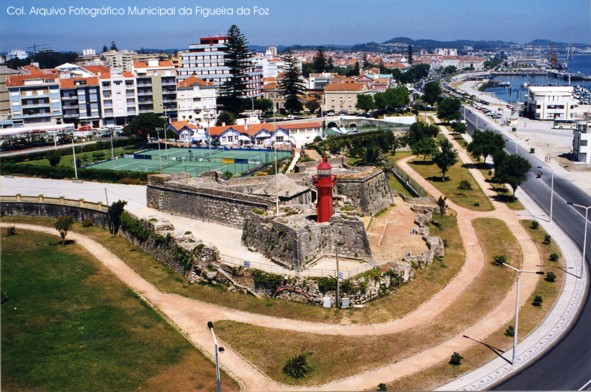
Forte de Santa Catarina stands on a rocky outcrop at the entrance of the Mondego river mouth, marking the northern end of Praia da Claridade. The fortress was built in the late 16th century after men from the Coimbra city hall petitioned King Philip I in October 1585 for a defensive structure to protect the bay from pirate raids — a fear that proved well-founded when English privateers sacked the fort in 1602.
The fort has an unusual triangular plan, adapted to the irregular terrain on which it stands. Contemporary military treatises advised against such an angle, and the design drew criticism for the very sharp face of one of its bastions, which was thought to compromise defensive fire. The remaining bastions show the classic swallowtail shape of the period. Inside the courtyard stands the small Chapel of Santa Catarina de Ribamar, built around 1598 in a Mannerist style, and the barracks where the garrison was housed.
In 1808 the fort was briefly occupied by Napoleonic troops during the third French invasion. A Portuguese detachment recovered the position shortly after, dismantled the French artillery, and secured the area around Lavos for the landing of Sir Arthur Wellesley — the future Duke of Wellington — a turning point in the Peninsular War.
The site was classified as a Property of Public Interest in 1961 and fully restored between 2014 and 2016. It houses a permanent exhibition on its history and the Peninsular War, alongside a tapas and cocktail bar inside the walls.
Destacados
- Late 16th-century coastal fortress at the mouth of the Mondego
- Unusual triangular plan that contradicted contemporary military treatises
- Secured the Lavos landing of the future Duke of Wellington in 1808
- Restored 2014–2016 with a permanent exhibition on the Peninsular War
- Tapas and cocktail bar inside the historic walls
History & context
The fort was raised on a rocky promontory historically known as Monte de Santa Catarina, financed by revenues from the town of Buarcos, the University of Coimbra, the Cathedral Chapter and the Monastery of Santa Cruz. It cooperated with the nearby Fortress of Buarcos and the Palheiros Fortlet to guard the port and bay against the raiding parties that plagued the Portuguese coast in the 16th and 17th centuries. After reinforcement works in 1643 brought its artillery up to fifteen pieces, the fort gradually lost military relevance, and by 1680 a survey already reported it in ruins. The 19th century saw it repurposed for civilian uses, including a lifesaving station in 1911 and, briefly, the local tennis club. The red iron lighthouse at the centre of the courtyard, raised in the early 20th century, was deactivated in 1991 but remains the fort's most photographed feature.
🗓️ Mejor época para visitar
Late afternoon for the light on the red lighthouse and Mondego mouth; year-round for the exterior
⏱️ Duración
30–45 minutes for the fort and chapel; longer with exhibition
♿ Accesibilidad
Uneven stone paths and steps inside the fort; not fully accessible for wheelchairs
Preguntas frecuentes
When was Forte de Santa Catarina built?
Construction began in the late 16th century after a petition from the Coimbra city hall to King Philip I in October 1585. The fort was raised on rocks known as Monte de Santa Catarina, at the mouth of the Mondego river.
Why is the plan triangular?
The unusual triangular shape was dictated by the irregular rocky terrain. Military treatises of the time advised against such sharp angles, but the design was kept and proved serviceable for over two centuries.
What is the fort's connection to the Duke of Wellington?
In 1808, after Napoleonic troops occupied the fort during the third French invasion, a Portuguese detachment recovered it and secured the nearby beach at Lavos for the landing of Sir Arthur Wellesley — the future Duke of Wellington — a decisive moment in the Peninsular War.
Can I visit the inside?
Yes, when exhibitions or seasonal programming are running. The interior houses a permanent exhibition on the fort's history and includes a small Mannerist chapel and a tapas bar. Check the Câmara Municipal website for current opening dates.
Is it free to enter?
General access to the exterior and main courtyard is free. Some temporary exhibitions or events inside may carry a small fee.