
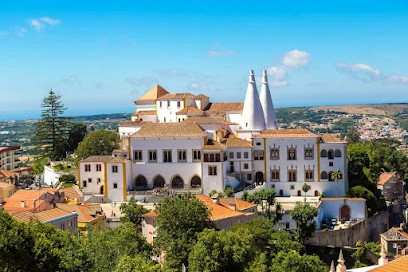
The National Palace of Sintra (Palácio Nacional de Sintra), often called the "Palácio da Vila" by locals, is the best-preserved medieval royal palace in Portugal and the oldest of Sintra's monuments. It sits in the historic centre of Sintra Vila — not on the mountain like Pena Palace — instantly recognisable by its two 33-metre white conical chimneys rising above the town.
The palace has roots in Moorish occupation: the earliest structures date from the 10th century, when a small Muslim alcáçova stood on the same hilltop. After the Christian reconquest in 1147, Portuguese kings adopted and expanded the residence over five centuries. The bulk of what visitors see today was built under King João I in the early 15th century, with Manueline additions ordered by King Manuel I in the early 16th century. Unlike most European royal palaces, no single architect designed it — successive monarchs added wings, halls and details until it became a layered architectural palimpsest.
Destacados inside include the Swans Hall (Sala dos Cisnes), with 27 painted swans on the ceiling commissioned by João I; the Magpies Hall (Sala das Pegas), where 136 magpies adorn the ceiling — each holding the king's motto "Por Bem" (For the Good); and the Coat of Arms Hall (Sala dos Brasões), a domed Manueline masterpiece displaying the heraldry of 72 Portuguese noble families.
The palace remained a royal residence until 1910 and is now a UNESCO World Heritage Site (part of the Cultural Landscape of Sintra, listed in 1995). Plan 60–90 minutes for the visit.
Destacados
- Best-preserved medieval royal palace in Portugal
- Iconic 33-metre conical chimneys — Sintra's most recognisable skyline
- Built on 10th-century Moorish foundations; expanded across 5 centuries
- Manueline masterpiece: Coat of Arms Hall with 72 noble heraldries
- Magpies Hall — 136 painted magpies, each holding "Por Bem" motto
- Royal residence from 12th century until 1910
- UNESCO World Heritage Site (part of Cultural Landscape of Sintra)
- Right in Sintra Vila — 5 minutes walk from the train station
History & context
The National Palace of Sintra is Portugal's longest continuously occupied royal residence. The hilltop on which it stands was first fortified in the 10th century by Moorish rulers, who built a small alcáçova (citadel residence) commanding the road between Lisbon and the Atlantic. When King Afonso Henriques captured Sintra in 1147 as part of the Christian Reconquista, the Portuguese crown adopted the Moorish residence and gradually expanded it.
The palace as visitors see it today is the work of two kings in particular. João I (r. 1385–1433), founder of the Avis dynasty, commissioned the central wing in the early 15th century — including the Swans Hall (Sala dos Cisnes) with its 27 painted swans, said to be inspired by his wife Philippa of Lancaster's English heritage, and the Magpies Hall (Sala das Pegas), whose 136 magpies bear the king's motto "Por Bem" (literally "For the Good"). Legend has it the magpies were João's response to court gossip after he was caught kissing a lady-in-waiting — one magpie for each chattering lady at court.
Manuel I (r. 1495–1521), known as "the Fortunate," added the most extravagant Manueline interventions, including the Coat of Arms Hall (Sala dos Brasões) — a square chamber crowned with a wooden dome displaying the heraldic shields of 72 Portuguese noble families, with the royal coat of arms at the apex. Tiled azulejo walls below run riot with hunting scenes.
Subsequent monarchs continued to use the palace as a summer residence well into the late 19th century. King Manuel II — the last Portuguese king — was the final royal to sleep there, in October 1910, just days before the republican revolution. The palace was nationalised in 1910 and opened to the public in 1911. UNESCO inscribed it as part of the Cultural Landscape of Sintra in 1995, and it remains one of the most-visited monuments in Portugal.
🗓️ Mejor época para visitar
Any month — indoor visit. Arrive at opening to avoid tour groups.
⏱️ Duración
60–90 minutes
♿ Accesibilidad
Partial. Ground floor accessible; upper floors require stairs. Free entry for reduced mobility +1.
Preguntas frecuentes
Is the National Palace of Sintra the same as Pena Palace?
No — they're completely different palaces. The National Palace (Palácio Nacional de Sintra) sits in the historic town centre of Sintra Vila, with two iconic white conical chimneys; it's medieval and was the royal residence from the 12th century. Pena Palace is the colourful Romantic palace on the mountaintop above town, built in the 1840s–50s. Both are worth visiting and are often combined in a single day in Sintra.
How do I get there from Sintra train station?
It's a 5-minute downhill walk. Leave the station, follow the main road into the historic centre — the white chimneys are visible from most points in town. The palace is right in Praça da República, the main square. No bus needed.
How long should I plan for the visit?
60–90 minutes is comfortable for the full interior tour. The palace has roughly 30 rooms open to the public, and the recommended route is well-signed. If you're doing the Sintra "big three" (National Palace + Pena + Moorish Castle or Quinta da Regaleira) in one day, plan the National Palace first as it's in town.
Is the palace accessible for wheelchairs and strollers?
Partially. The ground floor (including the kitchen with the famous chimneys, the Swans Hall, and the Magpies Hall) is wheelchair-accessible. The upper floors involve stairs. Free entry is provided for visitors with reduced mobility and one companion.
What are the two giant white chimneys for?
They're the chimneys of the royal kitchen, originally built in the 14th–15th centuries. The conical shape funnels smoke up from the fires below — at peak banquet times, several oxen could be roasted simultaneously inside the cavernous kitchen. The chimneys are 33 metres tall and have become the unofficial symbol of Sintra.