
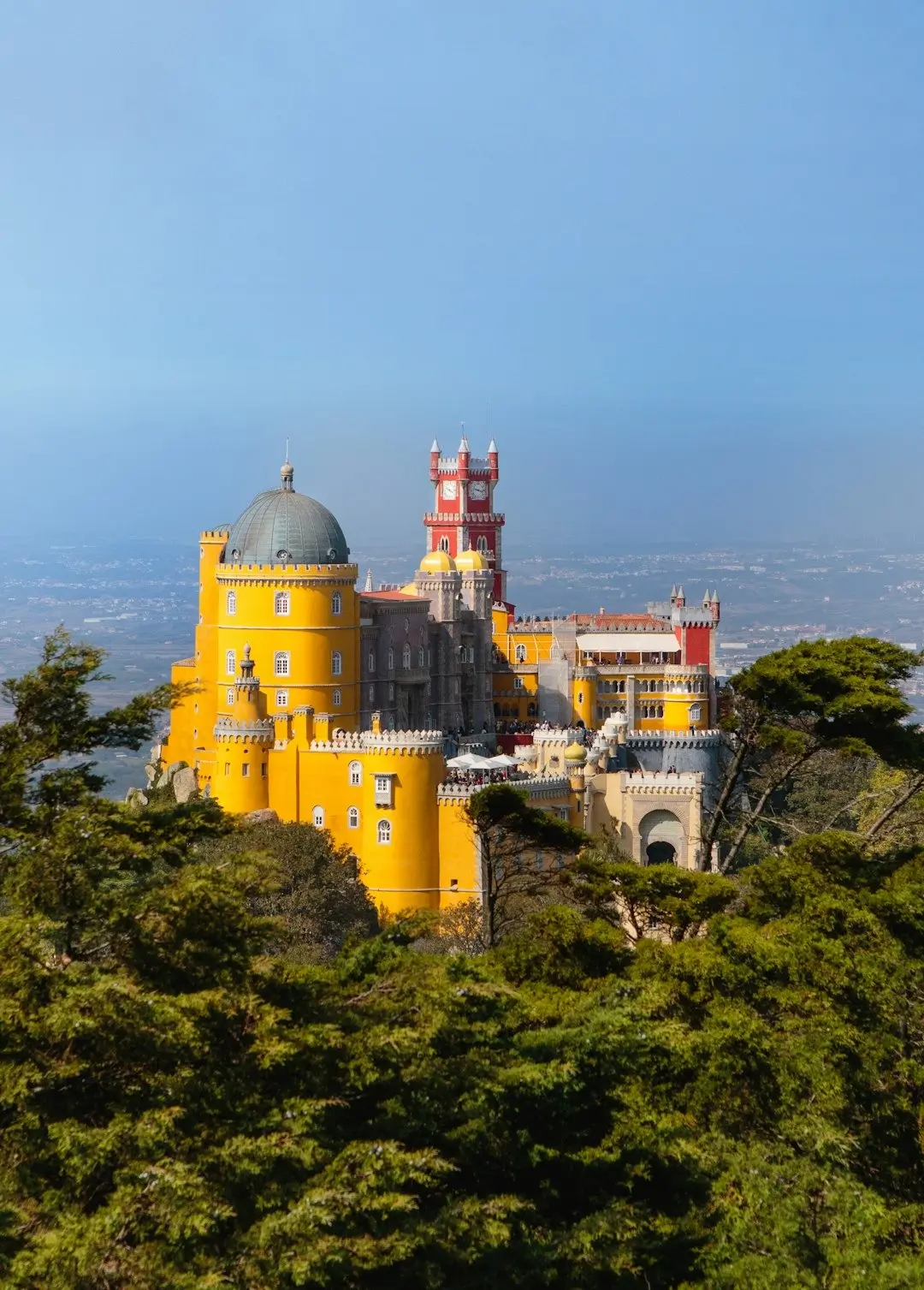
Pena Palace (Palácio da Pena) is Portugal's most photographed monument and the country's most flamboyant Romanticist palace. Perched on a rocky outcrop in the Sintra mountains at 480 metres above sea level, its yellow, terracotta and azulejo-tiled facades clash spectacularly with the green forest below — a deliberate, almost theatrical aesthetic dreamed up in the 1840s.
The palace was the brainchild of King Ferdinand II of Saxe-Coburg-Gotha, who in 1838 bought the ruins of a 16th-century Hieronymite monastery and spent the next two decades transforming the site into a Romantic fantasy. Designed by German architect Baron von Eschwege, the building blends Moorish horseshoe arches, Manueline ornamentation, Gothic turrets, and Bavarian colour palettes — all on a single hilltop. It was completed in 1854 and used as the royal family's summer residence until the establishment of the Republic in 1910.
Today Pena is a UNESCO World Heritage Site (part of the Cultural Landscape of Sintra, listed in 1995) and one of the official Seven Wonders of Portugal. The interior preserves rooms exactly as they were when the royal family fled — Queen Amélia's bedroom, the Indian Room, the Stag Room, the chapel — frozen in late-19th-century domestic life.
The surrounding Pena Park (Parque da Pena) covers 200 hectares and is half the experience: exotic trees brought from around the world, hidden grottos, two lakes, the Chalet of the Countess of Edla, and viewpoints that take in Sintra, Cascais and on clear days the Atlantic. Plan at least 3 hours for palace + park combined.
Destacados
- UNESCO World Heritage Site (since 1995, part of Cultural Landscape of Sintra)
- One of the official Seven Wonders of Portugal (2007)
- Built 1838–1854 by King Ferdinand II on a former Hieronymite monastery
- Yellow + red + azulejo facades visible from across the Sintra region
- Surrounded by 200-hectare Pena Park with exotic trees and viewpoints
- Interior rooms preserved as they were when the royal family fled in 1910
- Best photographed from the Cruz Alta viewpoint inside the park
- Allow 3+ hours for palace + park; arrive at opening to avoid crowds
History & context
Pena Palace was born from one of Europe's earliest Romantic dreams. In 1838 Prince Ferdinand of Saxe-Coburg-Gotha — King Consort of Portugal, husband of Queen Maria II — bought the ruins of a 16th-century Hieronymite monastery destroyed in the 1755 Lisbon earthquake and the 1834 dissolution of religious orders. Inspired by the German Romantic movement and German castles like Stolzenfels, he commissioned engineer Baron Wilhelm Ludwig von Eschwege to design a flamboyant new royal summer residence on the site.
Construction lasted from 1842 to 1854. The result was unlike anything in Portugal: a building that deliberately mixed Manueline, Moorish, Gothic and Renaissance elements, painted in vibrant yellow and ochre red — colours specifically chosen to be visible from Lisbon on clear days. Ferdinand also designed the 200-hectare park, importing trees from North America, Australia, China and Japan to create an experimental botanical landscape.
After Ferdinand's death in 1885 the palace passed through several royal hands. King Carlos and Queen Amélia used it as a regular summer residence; their son Manuel II was the last king to sleep there, just weeks before the 1910 republican revolution sent the royal family into exile. The palace was nationalised in 1911 and opened as a museum the same year — meaning the rooms have been preserved with their furniture, paintings and personal items as they were left.
In 1995 the Cultural Landscape of Sintra (including Pena, Moorish Castle, Monserrate and Quinta da Regaleira) was inscribed as a UNESCO World Heritage Site. In 2007 Pena Palace was voted one of the Seven Wonders of Portugal in a national poll. Today it draws nearly 3 million visitors a year, making it the most-visited monument in Portugal after Belém Tower and Jerónimos.
🗓️ Mejor época para visitar
April–May or September–October. Arrive at 09:30 to beat the crowds.
⏱️ Duración
3 hours (palace + park)
♿ Accesibilidad
Partial. Shuttle bus from lower gate (€3). Lower floors only; park has steep paths.
Preguntas frecuentes
When is the best time of day to visit Pena Palace?
Arrive at the gates 15 minutes before opening (09:30) to get in with the first group, ahead of tour buses that start arriving around 10:30. Early visitors get the palace's interior rooms nearly empty and the exterior photos without crowds. Late afternoon (after 16:30) is the second-best window — most tour groups have left and the light on the yellow facade is golden. Avoid midday and weekends, especially in summer.
How do I get to Pena Palace from Lisbon?
Catch the train from Rossio station to Sintra (~40 min, €2.30 each way). From Sintra station, the easiest option is bus 434, a hop-on-hop-off loop that takes you up to Pena and Moorish Castle and back (€7.60 return). Tuk-tuks and taxis also wait at the station. Driving is possible but parking near the palace is limited and the road is steep and narrow — bus 434 is recommended.
How long should I plan for the visit?
At least 3 hours total. Allow about 60 minutes for the palace interior, 60–90 minutes for the surrounding Pena Park (grotto, lakes, Chalet of the Countess), and time for queuing and walking up. If you also want to visit the Moorish Castle or Quinta da Regaleira on the same day, plan a full day in Sintra.
Do I need to book tickets in advance?
Highly recommended, especially in summer and on weekends. The palace operates time-slot entry — you choose a 30-minute window when booking. Walk-up tickets are sometimes available but you may wait 1–2 hours for the next slot. Buy online at parquesdesintra.pt for €1 discount and skip the ticket queue.
Is Pena Palace accessible for wheelchairs and strollers?
Partially. The steep cobblestone approach makes the climb difficult — there's a shuttle bus from the lower gate to the palace entrance for €3 return. Inside the palace, the lower floors are accessible but the upper royal apartments involve stairs. Pena Park has gravel paths with significant inclines; the main viewpoints near the palace are reachable, but exploring the full park requires steep walking.