
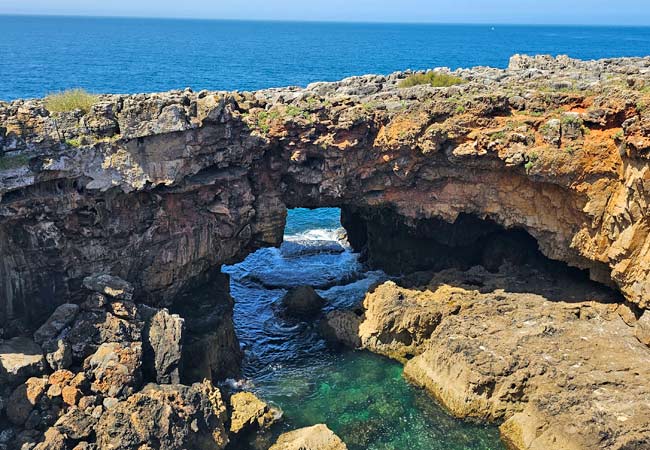
Boca do Inferno — the Mouth of Hell — is a chasm in the limestone cliffs just west of Cascais, where the roof of a sea cave collapsed long ago, leaving an open arch and cauldron into which the Atlantic drives with each swell.
On calm days it is a beautiful geological curiosity, the water glowing turquoise under the arch; in a winter storm it becomes genuinely thunderous, hurling spray high above the viewing terraces. The site is free and always open, with railed viewpoints, a small cluster of stalls and a café above the cliff.
It sits twenty minutes' walk from the old town along the coast road, past the Santa Marta lighthouse and the Casa das Histórias — the classic Cascais seafront stroll, best timed for late afternoon when the light falls onto the cliffs and the sun sets over the sea.
Destacados
- Collapsed sea cave with a natural rock arch
- Atlantic swells surging into the chasm
- Free, open viewpoints above the cliffs
- Spectacular in big winter seas; turquoise in calm weather
- A 20-minute coastal walk from the old town
History & context
The chasm formed as the sea undermined and collapsed a limestone cave. Famous since the 19th century, it drew early film-makers — a 1896 short of waves at Boca do Inferno is among the first films shot in Portugal — and the occultist Aleister Crowley faked his suicide here in 1930.
🗓️ Mejor época para visitar
Late afternoon for the light, sunset for the views; storm days for the full spectacle (keep behind the rails).
⏱️ Duración
30 minutes
♿ Accesibilidad
Paved access from the road to the main viewpoints; lower platforms involve steps and uneven rock.
Preguntas frecuentes
When is it most impressive?
With a big Atlantic swell — typically autumn and winter — when waves explode inside the chasm. On calm summer days it is scenic rather than dramatic.
Does it cost anything?
No — the viewpoints are free and always open, with a café and stalls above the cliff.