
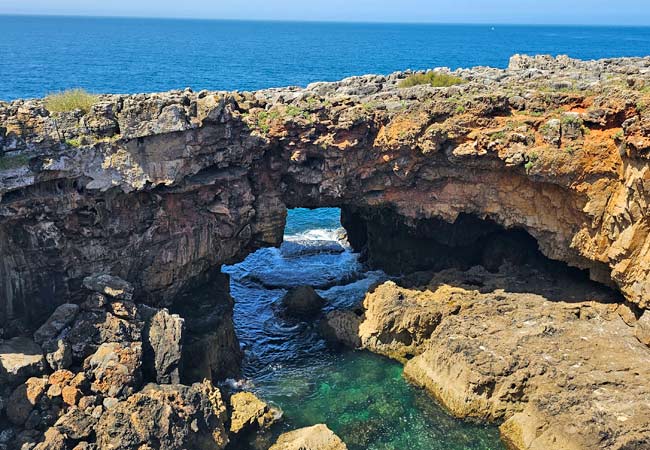
Boca do Inferno, the Mouth of Hell, is a chasm in the limestone cliffs just west of Cascais, where the roof of a sea cave collapsed long ago, leaving an open arch and cauldron into which the Atlantic drives with each swell.
On calm days it is a beautiful geological curiosity, the water glowing turquoise under the arch; in a winter storm it becomes genuinely thunderous, hurling spray high above the viewing terraces. The site is free and always open, with railed viewpoints, a small cluster of stalls and a café above the cliff.
It sits twenty minutes' walk from the old town along the coast road, past the Santa Marta lighthouse and the Casa das Histórias, the classic Cascais seafront stroll, best timed for late afternoon when the light falls onto the cliffs and the sun sets over the sea.
Highlights
- Collapsed sea cave with a natural rock arch
- Atlantic swells surging into the chasm
- Free, open viewpoints above the cliffs
- Spectacular in big winter seas; turquoise in calm weather
- A 20-minute coastal walk from the old town
History & context
The chasm formed as the sea undermined and collapsed a limestone cave. Famous since the 19th century, it drew early film-makers, a 1896 short of waves at Boca do Inferno is among the first films shot in Portugal, and the occultist Aleister Crowley faked his suicide here in 1930.
Frequently asked questions
When is it most impressive?
With a big Atlantic swell, typically autumn and winter, when waves explode inside the chasm. On calm summer days it is scenic rather than dramatic.
Does it cost anything?
No, the viewpoints are free and always open, with a café and stalls above the cliff.