
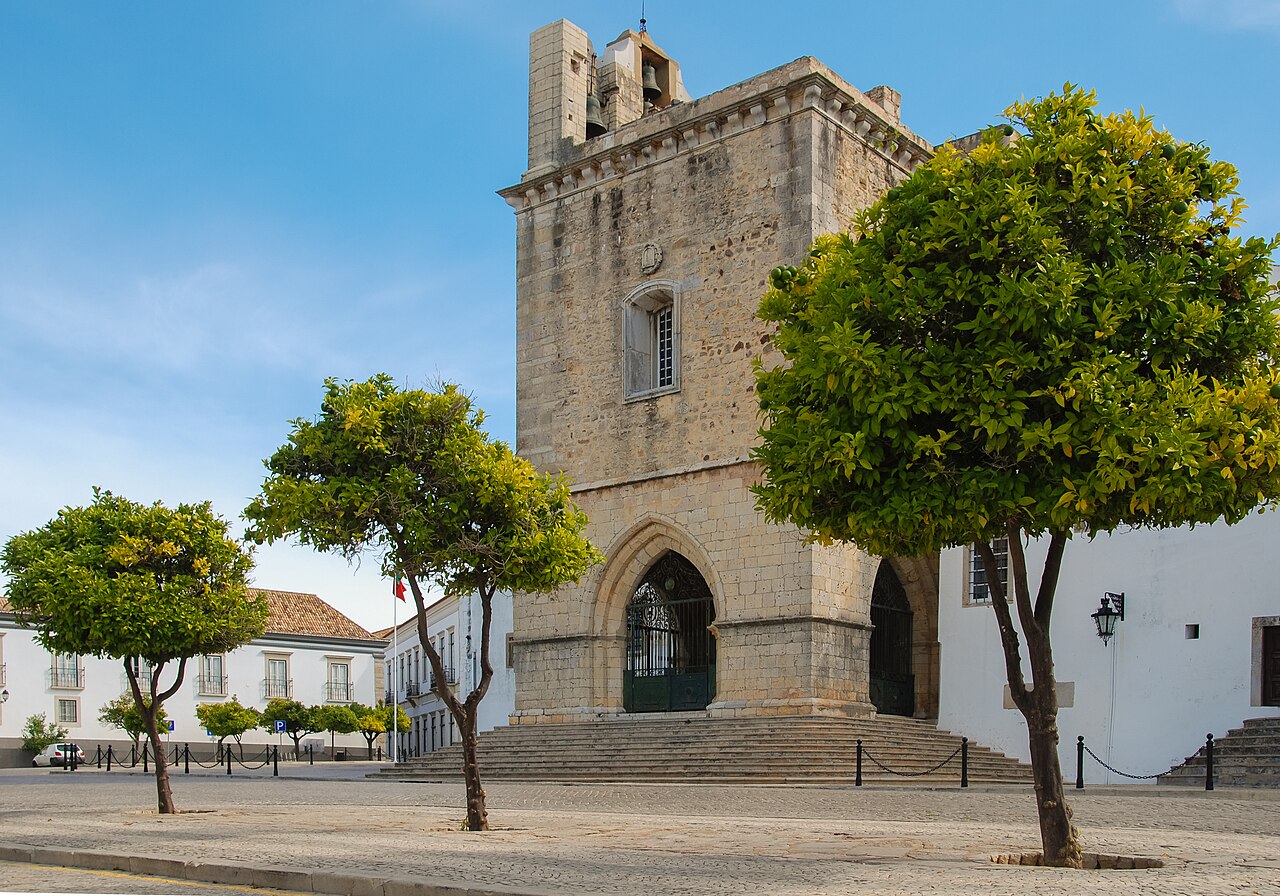
Faro Cathedral (Sé de Faro) is the religious and architectural heart of the city, standing at the centre of the cobbled Largo da Sé in the walled Old Town (Cidade Velha). Founded in 1251 — shortly after King Afonso III completed the Christian Reconquest of Faro in 1249 — the cathedral was built on a site with at least three earlier religious functions: a Roman temple, a Visigothic Christian church, and finally a mosque from the Moorish period (8th–13th centuries). Each successive structure was demolished and rebuilt, but archaeological evidence of the older layers has been uncovered during restoration work.
The cathedral has been damaged and rebuilt repeatedly across the centuries. In 1596 English troops under Robert Devereux, 2nd Earl of Essex, sacked Faro and set the cathedral on fire as part of an Anglo-Spanish War campaign — the same expedition that famously looted the Bishop's Library, taking books that eventually formed part of the Bodleian Library at Oxford. Then in 1755 the great Lisbon earthquake nearly destroyed the building entirely; only parts of the Gothic exterior and a few chapels survived.
The post-1755 reconstruction transformed the interior. Today the cathedral is one of the finest examples of Portuguese Baroque in the Algarve, decorated with elaborate gilded wood carving (talha dourada), intricate azulejo tile panels in geometric and figurative styles, and a series of Baroque altarpieces. The remaining medieval Gothic doorway and bell tower stand as reminders of the original 13th-century building.
The bell tower is the highlight for most visitors — a staircase of approximately 68 steps leads to a viewing platform with what is widely considered the best panorama in Faro. From the summit you see the entire Old Town below, the modern city stretching north, and the lagoons and barrier islands of the Ria Formosa Natural Park extending towards the Atlantic. The cathedral complex also includes a small Sacred Art Museum with statues, altarpieces, vestments, chalices, and religious paintings. Tickets €3.50; closed Sundays.
Destacados
- Founded 1251 — built on a Roman temple, Visigothic church and Moorish mosque site
- Bell tower with 68 steps and the best panoramic view in Faro
- Mix of Gothic exterior, Renaissance and Baroque interior
- Elaborate gilded wood carving (talha dourada) and azulejo tile panels
- Sacked and burned by English troops of the Earl of Essex in 1596
- Nearly destroyed in the 1755 Lisbon earthquake; rebuilt in Baroque style
- Sacred Art Museum included with €3.50 ticket
- Located at the heart of Faro's Old Town (Largo da Sé)
History & context
Faro Cathedral was founded in 1251, just two years after King Afonso III completed the Christian Reconquest of Faro on 27 March 1249 — the last major southern Portuguese city to be retaken from Muslim rule. The cathedral was built directly on the site of the city's principal Friday mosque, which had itself been constructed centuries earlier on the foundations of a Visigothic church (5th–7th centuries) and an even earlier Roman temple. Archaeological excavations during 20th-century restorations confirmed the layered religious history of the site.
The original 13th-century cathedral was a sober Gothic structure with a single tower, modest in proportions compared to other Portuguese cathedrals of the period. Significant expansion in the 15th and 16th centuries added chapels and Renaissance decorative elements.
The building suffered two catastrophic events that shape its present form. In 1596, during the Anglo-Spanish War, an English raiding force led by Robert Devereux, 2nd Earl of Essex — favourite of Queen Elizabeth I — landed in Faro, sacked the city, and set the cathedral on fire. The most famous loss was the Bishop's Library of Jerónimo Osório, whose 200 looted books eventually formed part of the Bodleian Library at the University of Oxford, where some still survive. Then in 1755 the great Lisbon earthquake devastated the entire Algarve, and Faro Cathedral was nearly destroyed — only parts of the Gothic facade, the bell tower, and a few chapels survived.
The reconstruction across the second half of the 18th century gave the interior its present Baroque character. The cathedral was redecorated with elaborate gilded wood carving (talha dourada), an extensive programme of azulejo tile panels, and a series of new altarpieces — all expressions of the Portuguese Late Baroque "Joanino" and early Pombaline styles. The cathedral was classified as a National Monument in 1910 and remains the seat of the Bishop of the Algarve. The Sacred Art Museum within the complex was added in the 20th century to display religious art, vestments and silver from the diocese.
🗓️ Mejor época para visitar
Any season. Late afternoon for soft light on the gilded interior and tower view.
⏱️ Duración
45–60 minutes
♿ Accesibilidad
Cathedral nave accessible; bell tower has 68 steps and is not wheelchair-accessible.
Preguntas frecuentes
How do I get to Faro Cathedral and where is the entrance?
The cathedral se encuentra en la heart of Faro's Old Town (Cidade Velha), on Largo da Sé — a 5-minute walk from either the Arco da Vila (entering from the marina side) or the Arco do Repouso (entering from the eastern side). The main entrance and ticket office are on the cathedral facade facing the square. Tickets cost €3.50 and include the cathedral interior, bell tower, and sacred art museum.
Can I climb the bell tower, and is the view worth it?
Yes — and many visitors say the tower view is the single best thing to do in Faro. A spiral staircase of around 68 steps leads to a small viewing platform at the top. From there you can see the entire Old Town directly below, the modern Faro city to the north, and the Ria Formosa lagoon with its barrier islands extending towards the Atlantic. Best at late afternoon for soft light. Allow 15–20 minutes for the climb up and down.
What are the opening hours?
Monday–Friday: 10:00–18:30 (closing at 18:00 in December and January). Saturday: 09:30–13:00 (mornings only). Closed all day Sunday. Last entry around 30 minutes before closing. The cathedral hosts mass on Sundays — visitors can attend the service but tourist visits resume Monday morning.
How long should I plan for the visit?
45–60 minutes is comfortable for the cathedral interior, the small Sacred Art Museum, and a slow climb up the bell tower for views and photos. If you're particularly interested in church history or want to study the Baroque carvings, plan 75–90 minutes. Combine with a walking tour of the Old Town (Cathedral + Municipal Museum + Arco da Vila + Arco do Repouso) for a half-day in historic Faro.
Is the cathedral accessible for wheelchairs?
Partially. The main cathedral nave is at ground level and accessible. The bell tower involves a narrow spiral staircase with approximately 68 steps and is not accessible. The Sacred Art Museum varies — most of the ground-floor displays are reachable. Visitors with reduced mobility can still appreciate the main cathedral and museum.