

Private Transfers in Lisbon — Airport & Day Trips
Private and reliable transfers in Lisbon – airport, hotel, business travel and day trips across Portugal.
Explore the best of Lisbon
Fast highlights + a full travel guide to plan Lisbon properly.
Lisbon is in the Lisbon & Surroundings region of Portugal, about 8 km from Lisbon Airport.
This page introduces Lisbon’s setting and history. For a closer look at individual sites — from Alfama to Belém — visit the landmarks section. Local dishes and where to find them are covered in food and gastronomy. Neighbourhood options and areas to consider are listed under where to stay, and the full guide brings everything together in one place.

Historic landmarks
Main monuments, best viewpoints, and what’s worth your time in Lisbon.
Belem Tower
Jerónimos Monastery
São Jorge Castle
Miradouro da Senhora do Monte
Praça do Comércio
Alfama
Hotels & stays
Book the right stay in Lisbon: best areas, smart picks, and options for every budget.

Delicious cuisine
What to eat, where locals go, and quick “must-try” food in Lisbon.
Bacalhau à Brás
Sardinhas Assadas (Grilled Sardines)
Pastel de Nata (Portuguese Custard Tart)
Ginjinha (Portuguese Sour Cherry Liqueur)
Caracóis (Portuguese Snails)
Travel guide to Lisbon
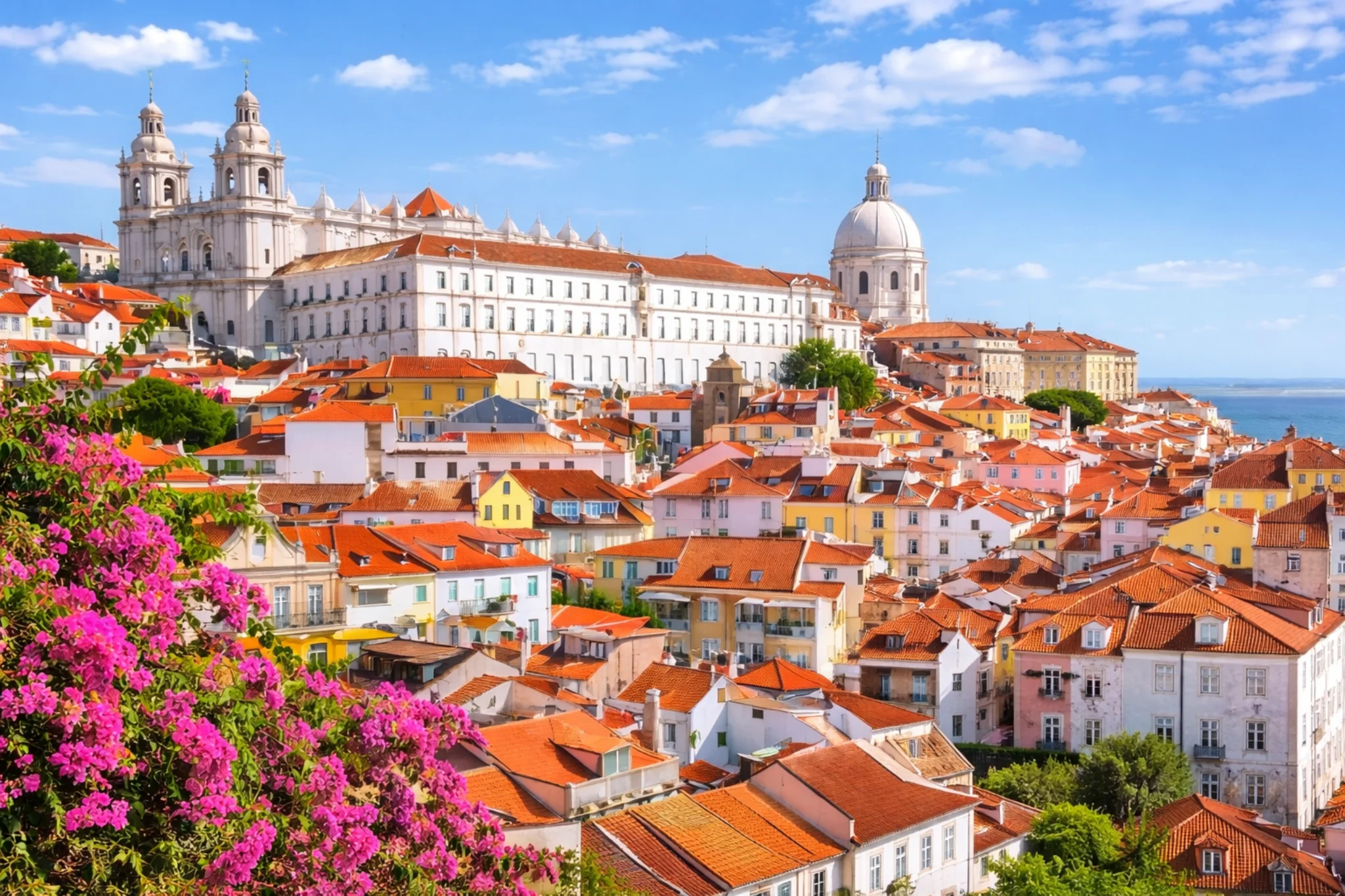
Lisbon, Portugal’s capital, is built across seven hills above the Tagus River estuary, where Atlantic light falls on medieval lanes, azulejo-tiled facades and neoclassical squares. The city’s compact historic core makes it navigable on foot, yet each neighbourhood carries a distinct character shaped by centuries of maritime trade and cultural exchange.
What to see in Lisbon
The oldest quarter, Alfama, rises steeply from the riverfront in a tangle of cobbled streets served by vintage trams, with intimate miradouros opening onto the estuary below. São Jorge Castle crowns the hill above Alfama and offers panoramic views across the city’s rooftops and the broad Tagus. To the west, the Belém district holds two of Lisbon’s most significant monuments: the Jerónimos Monastery, a late-Gothic masterpiece commissioned to celebrate the Vasco da Gama voyages, and the Belém Tower, a fortified river sentinel dating to the early sixteenth century.
Praça do Comércio anchors the lower city at the waterfront. The square was rebuilt in its current neoclassical form following the 1755 earthquake that destroyed much of Lisbon, and it remains the formal threshold between the city and the Tagus. For elevated perspectives, the Miradouro da Senhora do Monte is widely regarded as the finest viewpoint in the city, particularly in the late afternoon. A dedicated section covers Lisbon’s landmarks in full detail.
Food and local character
Lisbon’s food culture is rooted in Atlantic seafaring tradition. Bacalhau à Brás — dried salt cod shredded and cooked with matchstick potatoes and egg — appears on menus across every neighbourhood. Sardinhas assadas are a summer fixture at waterfront eateries, while pastel de nata, the caramelised custard tart, is produced by dedicated pastelerias throughout the city. Ginjinha, a sour cherry liqueur served in small ceramic cups, is a neighbourhood ritual found in traditional tasquinhas, and caracóis — braised snails seasoned with garlic and herbs — appear on outdoor tables from late spring onward. The cuisine section covers where and what to eat in greater depth.
Beyond the historic centre, Lisbon’s metropolitan area extends toward the coastal town of Cascais to the west and the hilltop palaces of Sintra, both reachable within an hour. Lisbon Airport (IATA: LIS) lies approximately 8 km north of the city centre and receives direct flights from North America and across Europe, making the city an efficient starting point for wider travel through Portugal.
Frequently asked questions
Quick answers, so you can book with confidence.
gotoo trips and transfers departs from Lisbon to all major Portuguese destinations: Porto (336 km · desde €395 / since €395), Faro / Algarve (270 km · desde €320 / since €320), Évora (136 km · desde €175 / since €175), Sintra (28 km · desde €55 / since €55) and hundreds of towns across Portugal. All routes include fixed pricing per vehicle, English-speaking drivers and optional sightseeing stops.
Yes. gotoo trips and transfers runs private city-to-city transfers from Porto to Lisbon (355 km · about 4 hours · desde €415 / since €415 per vehicle). Travellers often combine this journey with stops in Coimbra and Óbidos, making the most of the route. All transfers are private — your group travels alone with the driver, with no shared vehicles.
Yes. gotoo trips and transfers provides private transfers from Faro to Lisbon (270 km · about 3 hours · desde €320 / since €320 per vehicle). A popular route for travellers who want to continue from the Algarve to Lisbon — with the option to stop in Évora and Alcácer do Sal along the way.
Yes — this is one of the main reasons travellers choose gotoo trips and transfers. You can add up to two stops on any city-to-city route departing from Lisbon. Popular combinations include stopping at towns along the route to explore before continuing to the final destination. Add your stops at booking and we include them in the fixed price quote.
Yes. gotoo trips and transfers provides private city-to-city transfers to and from Lisbon, with departures from Lisbon, Porto and Faro. gotoo trips and transfers is a licensed Portuguese travel agency (RNAVT 10586) — not a technology platform — specialising in private transfers and day trips across Portugal, available 24/7 with English-speaking drivers.
For most travellers, a private transfer to Lisbon is more practical than public transport: it is door-to-door, runs on your schedule and allows stops at cities or landmarks along the route. gotoo trips and transfers charges per vehicle (not per person), making it competitive for groups of two or more. Book at gotoo.pt or via WhatsApp at +351 932 275 689.
Getting to Lisbon
Lisbon sits about 12 km from Lisbon Airport, roughly 15 minutes by road. Public transport often means changes and waiting, and may leave you a walk from where you want to be. A private transfer takes you door-to-door, with a fixed price and no connections — from €30 from Lisbon Airport.
Events in Lisbon
Upcoming festivals, exhibitions and cultural events in Lisbon, with dates and venues. Information is updated regularly from official tourism sources.

Turn around. Um olhar sobre a Coleção de Arte Fundação EDP
Turn around. Um olhar sobre a Coleção de Arte Fundação EDP runs from 11 February to 25 January 2027 at MAAT - Museu de Arte, Arquitetura e Tecnologia - Lisboa in Lisbon.
Turn Around offers a curated look at the Fundação EDP Art Collection, one of Portugal's largest institutional contemporary art holdings, with around 2,500 works by over 340 artists. Displayed at MAAT Central in two rotating presentations, the exhibition features roughly 100 works exploring the diversity of Portuguese artistic practices, with a focus on artists born after the 1974 Revolution.
Venue: MAAT - Museu de Arte, Arquitetura e Tecnologia - Lisboa · Official website

Olhos Múltiplos
Olhos Múltiplos runs from 14 May to 25 October 2026 at MAAT - Museu de Arte, Arquitetura e Tecnologia - Lisboa in Lisbon.
'Olhos Múltiplos' is a group exhibition at MAAT bringing together three artists from different generations who explore storytelling as a collaborative and political practice. The works challenge binary narratives and systems of control, inviting visitors to engage with otherness as an opportunity for reflection rather than a source of tension.
Venue: MAAT - Museu de Arte, Arquitetura e Tecnologia - Lisboa · Official website

Festival ao Largo
Festival ao Largo runs from 3 July to 25 July 2026 at Centro Cultural de Belém - Lisboa in Lisbon.
Festival ao Largo brings classical arts to a wider audience with free performances at the Centro Cultural de Belém. The program includes symphonic music, ballet, and theater, featuring ensembles such as the Portuguese Symphony Orchestra, the National Ballet Company, and the National Theatre D. Maria II.
Venue: Centro Cultural de Belém - Lisboa · Official website

Djodje
Djodje takes place on 29 August 2026 at Monsantos Open Air in Lisbon.
Cape Verdean artist Djodje returns to Lisbon for an intimate outdoor concert at Monsantos Open Air. Blending Zouk, R&B, Kizomba, and Afrobeats, he revisits highlights from his career alongside newer material. The show is designed around closeness and direct engagement with the audience.
Venue: Monsantos Open Air

TT | 20 anos de RNB | Come Closer
TT | 20 anos de RNB | Come Closer takes place on 5 September 2026 at Coliseu dos Recreios - Lisboa in Lisbon.
TT marks two decades of R&B with a concert at Coliseu dos Recreios in Lisbon, tracing the evolution of the genre through different phases and influences. The show is designed as an immersive experience, with a mid-concert segment where TT transforms the venue into a club setting. It blends intimacy and movement, inviting the audience to feel the music rather than simply watch it.
Venue: Coliseu dos Recreios - Lisboa · Official website

Gil Semedo: Caboswing – Novo e Velho Tour
Gil Semedo: Caboswing – Novo e Velho Tour takes place on 11 September 2026 at Coliseu dos Recreios - Lisboa in Lisbon.
Gil Semedo brings his Caboswing movement to Lisbon's Coliseu dos Recreios, blending African rhythms, pop, and contemporary influences across a career-spanning setlist. The show combines live music and dance with an immersive visual production using artificial intelligence, tracing the artist's role in shaping Cape Verdean music for diverse audiences.
Venue: Coliseu dos Recreios - Lisboa · Official website

Festival Caixa Alfama
Festival Caixa Alfama runs from 11 September to 12 September 2026 at Alfama - Lisboa in Lisbon.
The Festival Caixa Alfama brings fado music to life across multiple open-air stages in Lisbon's historic Alfama neighborhood. The lineup features established fado artists alongside emerging voices, offering a genuine look at this Portuguese musical tradition. Performances take place in the narrow streets and iconic spots of one of Lisbon's oldest districts.
Venue: Alfama - Lisboa · Official website

Deva Premal & Miten | Singing our Prayers
Deva Premal & Miten | Singing our Prayers takes place on 12 September 2026 at Coliseu dos Recreios - Lisboa in Lisbon.
Deva Premal & Miten return to Portugal for a live concert at the Coliseu dos Recreios in Lisbon. With over three decades of practice, the duo leads audiences through mantras, songs, and communal chanting as a form of meditation and emotional release. The evening blends music and mindfulness in a shared, participatory setting.
Venue: Coliseu dos Recreios - Lisboa · Official website

Ronnie Wood and His Band
Ronnie Wood and His Band takes place on 14 September 2026 at Coliseu dos Recreios - Lisboa in Lisbon.
Ronnie Wood, guitarist of the Rolling Stones, brings his band to Lisbon's Coliseu dos Recreios to mark six decades of music. The setlist draws from a career spanning The Birds, Jeff Beck Group, The Faces, and his solo work. His 2025 compilation FEARLESS: THE ANTHOLOGY 1965–2025 provides the backdrop for this celebratory show.
Venue: Coliseu dos Recreios - Lisboa · Official website

Schönbrunn Palace Orchestra Vienna (Lisboa)
Schönbrunn Palace Orchestra Vienna (Lisboa) takes place on 27 September 2026 at Aula Magna - Lisboa in Lisbon.
The Schönbrunn Palace Orchestra Vienna returns to Portugal with a program spanning waltzes, polkas, and operetta excerpts under the theme 'From Strauss to Léhar – An Evening Through Vienna's Golden Age.' The ensemble is recognized for its authentic Viennese sound, performing at Lisbon's Aula Magna.
Venue: Aula Magna - Lisboa · Official website

Coldday – Tributo a Coldplay TOUR 2026
Coldday – Tributo a Coldplay TOUR 2026 takes place on 21 January 2027 at Coliseu dos Recreios - Lisboa in Lisbon.
Coldday is a Coldplay tribute act known for faithful sound reproduction and high-energy performances. The band brings an immersive stage show featuring well-known songs like Yellow, Viva la Vida, and Fix You. The concert takes place at the historic Coliseu dos Recreios in Lisbon, as part of their 2026 world tour.
Venue: Coliseu dos Recreios - Lisboa · Official website

Thirty Seconds to Mars
Thirty Seconds to Mars takes place on 6 April 2027 at MEO Arena - Lisboa in Lisbon.
Thirty Seconds to Mars bring their 'A Beautiful Lie vs This Is War' world tour to Lisbon, revisiting two of the band's landmark albums. The show features classics like 'The Kill' and 'From Yesterday,' and marks the return of guitarist Tomo Milicevic alongside Jared and Shannon Leto.
Venue: MEO Arena - Lisboa · Official website
Routes starting in Lisbon
Private transfers departing from this city.
