
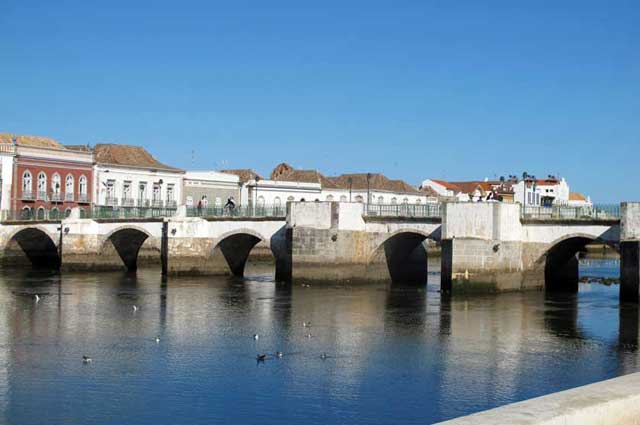
The Roman Bridge of Tavira, known locally as the Ponte Antiga, crosses the Gilão river at the very heart of the old town. It joins the main square, the Praça da República, to the streets and restaurants on the opposite bank, and its arches appear on the coat of arms of the town.
Despite the popular name, the bridge is not a Roman structure. A crossing has existed on or near the site since at least the medieval period, and the bridge served as a defended link, once flanked by towers and even fitted with a removable wooden section for security. The structure seen today, with its low arches, dates from a seventeenth-century reconstruction after an earlier collapse.
Now reserved for pedestrians, the bridge is one of the most photographed spots in Tavira. From the middle, long views open along the river in both directions, over the riverside cafés and the whitewashed houses with their distinctive four-sided roofs.
Highlights
- Seven-arched stone bridge over the Gilão river
- Joins the two halves of Tavira's historic centre
- Its arches feature on the town's coat of arms
- Present structure rebuilt in the seventeenth century
- A pedestrian bridge and a favourite photo spot
History & context
A bridge at Tavira is documented from the medieval period, and the Chronicle of the Conquest of the Algarve refers to a crossing here in the thirteenth century. The popular name suggests Roman origins, linked to the old road between Faro and Castro Marim, but the present structure is not Roman. After the earlier bridge collapsed in the seventeenth century, it was rebuilt — a project carried out under King João IV and completed around 1667, giving the bridge its current seven-arched form. It later carried road traffic before being reserved for pedestrians.
🗓️ Best time to visit
Early morning or sunset, when low light catches the river and the whitewashed houses. The riverside cafés are liveliest in the evening.
⏱️ Duration
10–15 minutes
♿ Accessibility
Good. The bridge deck is broadly level and reached easily from both banks, though the surface is cobbled.
Frequently asked questions
Is the Roman Bridge of Tavira really Roman?
No. Despite the name, the present bridge dates from a seventeenth-century reconstruction completed around 1667, though a crossing existed here much earlier.
Can the bridge be crossed on foot?
Yes, it is a pedestrian bridge linking the main square to the restaurants on the far bank of the Gilão.
Is there a fee to use the bridge?
No, it is a public bridge, open and free to cross at any hour.