
GoToo · Portugal
Day Trips from Lisbon: The 15 Best in 2026 (By a Local Operator)
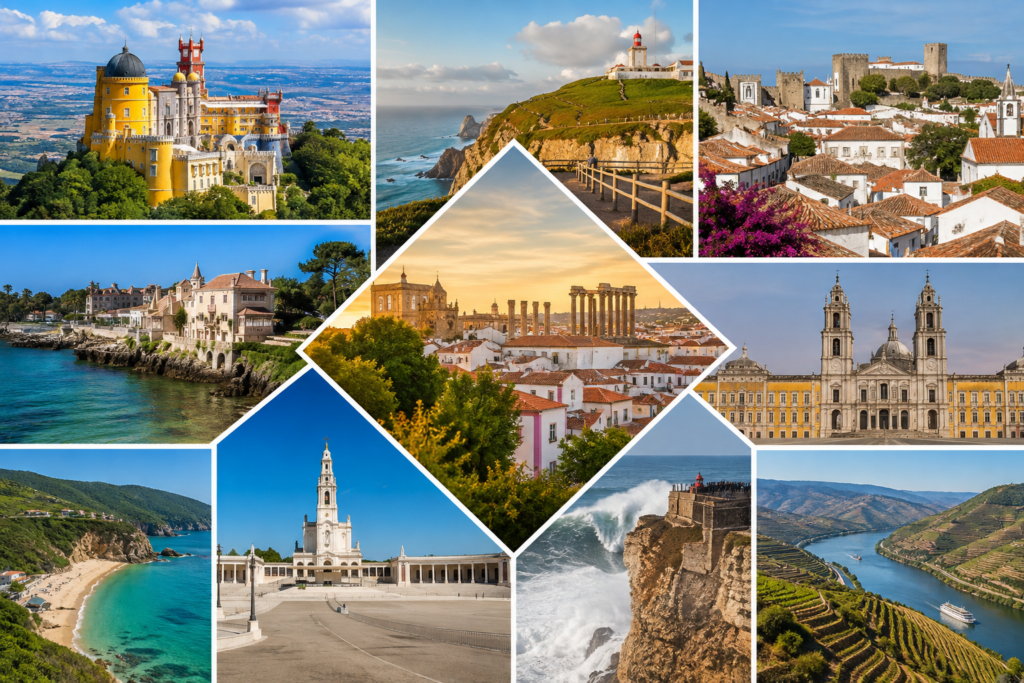
In short. The best day trips from Lisbon include Sintra's fairy-tale palaces, the medieval town of Óbidos, the beaches of Arrábida, the pilgrimage site of Fátima, and the riverside city of Porto. Most lie within 90 minutes of the capital and can be visited independently by train or coach, or more comfortably by private transfer with a driver who knows the routes and parking. Below you'll find 15 tested itineraries with practical advice on how to get there, what to see, and when to go.
1. Sintra: Palaces, Parks and Mountain Views
Sintra sits 30 km north-west of Lisbon, on a wooded mountain ridge that traps Atlantic cloud. The microclimate supports a tangle of ferns, camellias and oak, and cooling mist made the town a summer retreat for Portuguese royalty. Today it holds a UNESCO World Heritage cultural landscape of palaces, quintas and follies, all connected by cobbled lanes and forest trails.
Most visitors aim for Pena Palace, a Romantic hilltop confection painted ochre and raspberry, and Quinta da Regaleira, a neo-Manueline estate famous for its spiral initiation well. Both reward an early start, coach groups arrive around mid-morning. The Moorish Castle offers rampart walks and views across the plain to the Atlantic, while the National Palace in the town centre displays centuries of tilework and two enormous conical chimneys. Because the sites are spread across several kilometres of steep, narrow roads, a car or transfer saves time and energy.
The train from Rossio station takes 40 minutes and runs every 20 minutes; tickets cost a few euros each way. At Sintra station you'll need bus 434 or a taxi to reach the palaces uphill. Alternatively, a private transfer takes you door-to-door and waits while you visit, so you set the pace. For more detail on routes and ticketing, read our guide on getting from Lisbon to Sintra, and for an in-depth look at one of the most atmospheric estates, see our Quinta da Regaleira guide.
2. Cascais and Estoril: Seaside Promenade and Beaches
The train west from Cais do Sodré hugs the Tagus estuary and then the Atlantic coast, delivering you to Cascais in under 40 minutes. Once a fishing village, Cascais became fashionable in the late 19th century when the royal family summered there, and it remains an elegant resort with a marina, several small museums, and a seafront promenade lined with cafés and ice-cream kiosks.
Walk the paved coastal path west to Boca do Inferno, a wave-cut chasm where Atlantic swells throw spray, or cycle the other direction towards Guincho, a broad windswept beach popular with kite-surfers. Between Cascais and Lisbon, the railway stops at Estoril, home to a belle-époque casino and formal gardens. The trip suits families and anyone wanting easy access to sand and sea without leaving the Lisbon metro area.
3. Óbidos: Medieval Walls and Ginjinha
Óbidos stands on a limestone ridge 85 km north of Lisbon, its whitewashed houses enclosed by a circuit of medieval walls. You can walk the entire perimeter on top of the ramparts, narrow in places and without guardrails, for views over orange rooftops and the surrounding farmland. Inside the walls, cobbled lanes climb past artisan shops, small galleries and cafés serving the local sour-cherry liqueur, ginjinha, often poured into edible chocolate cups.
The town is compact, two hours covers the essentials, which makes it ideal for a half-day stop or a combination with another destination. Many visitors pair Óbidos with the pilgrimage basilica at Fátima or the Atlantic beach town of Nazaré. Driving takes around an hour via the A8 motorway; coaches and tour buses park outside the walls, so expect crowds in summer and at weekends. For a quieter experience, arrive before mid-morning or after lunch.
4. Fátima: Portugal's Principal Pilgrimage Site
Fátima lies 130 km north of Lisbon on the limestone plateau of Estremadura. In 1917 three shepherd children reported apparitions of the Virgin Mary, and today the Sanctuary of Our Lady of Fátima draws millions of pilgrims each year. The vast esplanade can hold half a million people during the major pilgrimages on 13 May and 13 October, but on quieter days it offers a serene space for reflection.
The complex includes the original Chapel of the Apparitions, the neo-classical Basilica of Our Lady of the Rosary, and the modern Basilica of the Holy Trinity, consecrated in 2007 and capable of seating 9,000. Whether you come for faith or for architecture, the site is meticulously maintained and free to enter. If you're arriving by cruise ship and short on time, you can visit Fátima comfortably, learn more about timing and transfers in our cruise-port guide.
There is no direct train; buses from Lisbon's Sete Rios station take around two hours. A private transfer cuts travel time and offers the flexibility to combine Fátima with Óbidos, Batalha monastery or the Knights Templar castle at Tomar on the return journey.
5. Arrábida Natural Park: Beaches, Vineyards and Turquoise Water
Cross the 25 de Abril bridge south and within 40 minutes you reach the Serra da Arrábida, a low limestone range that plunges into the Atlantic and shelters some of the clearest water near Lisbon. The park protects Mediterranean scrub, wild orchids and remnant cork forest, while the coast offers a string of small beaches with fine sand and calm, shallow bays ideal for families.
Portinho da Arrábida is the most photographed cove, its turquoise water framed by white cliffs and pine. Nearby Setúbal is a working fishing port and the gateway to the region's wine estates; the Moscatel de Setúbal, a fortified dessert wine, has been made here since the 15th century. Several quintas open for tastings, and a few offer lunch with views over vine terraces to the estuary.
Public transport in the park is limited; a car or transfer allows you to link beach stops with a winery visit and perhaps a detour to the cliff-top Convento da Arrábida, a 16th-century Franciscan retreat now used for conferences but visible from the road.
6. Évora: Roman Temple, Gothic Cathedral and Alentejo Plains
Évora stands 140 km east of Lisbon on the rolling wheat plains of the Alentejo. Its historic centre, encircled by medieval walls, holds a Roman temple with a dozen standing columns, a Gothic cathedral with cloisters and a rooftop terrace, and the eerie Chapel of Bones, its interior lined with the skeletons of 5,000 monks. The entire quarter is a UNESCO World Heritage site and remarkably well preserved.
Lunch in Évora means Alentejo cuisine, thick bread soups, slow-cooked pork with clams, and wines from nearby Reguengos or Borba. The town is small enough to explore on foot in three hours, though many visitors linger longer. Driving from Lisbon takes 90 minutes via the A6 motorway; there are also several daily buses and a slower regional train. However, a private transfer lets you stop at a countryside winery or the ancient stone circle at Almendres on the way back.
7. Porto and the Douro: Northern Portugal's Riverfront City
Porto sits 315 km north of Lisbon at the mouth of the Douro river. Its Ribeira district of pastel townhouses tumbles down to the waterfront, where traditional rabelo boats once delivered port-wine barrels from upriver quintas. Across the water in Vila Nova de Gaia, dozens of port lodges offer tours and tastings. The city's historic centre is a UNESCO site, and its café culture, tiled churches and avant-garde museums make it Portugal's second city in more than population alone.
The journey is too long for a rushed day trip, the direct Alfa Pendular train takes 2 hours 45 minutes, while driving on the A1 motorway takes about three hours in light traffic. Instead, consider an overnight stay or, if time is genuinely tight, focus on destinations closer to Lisbon. For timetables and booking advice, see our Lisbon to Porto guide.
8. Nazaré: Big Waves and a Traditional Fishing Beach
Nazaré lies 125 km north of Lisbon on the Costa de Prata, a stretch of Atlantic coast known for strong swells and seafood. The town divides into a lower beach quarter, where fisherwomen still spread nets to dry, and an upper clifftop district reached by funicular. In winter the Praia do Norte, just north of the headland, produces some of the tallest surfable waves on earth, the underwater Nazaré Canyon funnels deep-ocean energy into monstrous walls of water that can exceed 20 metres.
Between November and February, big-wave surfers and crowds gather to watch the Atlantic perform. The rest of the year Nazaré is quieter, and you can enjoy grilled sardines at a beachfront grill, browse the covered market, or simply walk the long sandy shore. Driving from Lisbon takes 90 minutes; combining Nazaré with Óbidos on the return makes a full but rewarding day.
9. Mafra and Ericeira: Baroque Palace and Surf Town
Mafra, 40 km north-west of Lisbon, is dominated by the Palácio Nacional de Mafra, a colossal baroque complex built in the early 18th century to fulfil a vow by King João V. The palace contains 1,200 rooms, a basilica with six organs, and a Rococo library holding tens of thousands of leather-bound volumes. Guided tours take you through royal apartments, infirmary and monks' cells.
Ten kilometres west, the fishing village of Ericeira perches on low cliffs above a series of reef breaks that make it a World Surfing Reserve. Even if you don't surf, the town offers fresh seafood, a laid-back atmosphere and coastal walks. Pairing Mafra's grandeur with Ericeira's simplicity fills a leisurely day and shows two contrasting faces of the Lisbon region.
10. Tomar and the Convent of Christ
Tomar sits 140 km north-east of Lisbon on the banks of the river Nabão. Above the old town rises the Convent of Christ, a fortified complex that began as the headquarters of the Knights Templar in the 12th century and grew over four centuries into a showcase of architectural styles from Romanesque to Manueline. The circular Templar church, modelled on Jerusalem's Holy Sepulchre, and the ornate Manueline window of the chapter house are the highlights.
The town itself is pleasant and walkable, with riverside gardens and a modest grid of streets laid out by the Templars. Tomar pairs well with Fátima or Batalha monastery for a loop through central Portugal. Driving takes around 90 minutes each way; there are trains, but they involve a change and take longer than the bus or a direct transfer.
11. Comporta and the Tróia Peninsula
South across the Tagus estuary, the Tróia peninsula and the village of Comporta offer long Atlantic beaches backed by pine forest and rice paddies. The area has remained low-key despite recent development, and the wide sands are never as crowded as those closer to Lisbon. Tróia itself is a resort peninsula with a marina and golf courses; Comporta village consists of little more than a few cafés and design shops in traditional thatched buildings.
Access is either by car ferry from Setúbal to Tróia or by road via the longer route around the estuary. The journey rewards those seeking a quieter beach day or a taste of rural Alentejo coastal life. Combine it with Arrábida Natural Park for a full day exploring the Setúbal peninsula.
12. Almada: Cristo Rei and Panoramic Views
Almada lies directly across the Tagus from Lisbon, and its Cristo Rei statue, modelled on Rio's Christ the Redeemer, offers the finest panoramic view of the capital. The monument stands 110 metres above the river, with a lift and stairs to an observation platform at the statue's base. On a clear day you can see from the Alfama to Belém and out to the Atlantic horizon.
Because Almada is so close, it works as a morning or afternoon add-on rather than a full day trip. You can reach it by ferry and bus, but a transfer lets you combine the viewpoint with a beach stop at Costa da Caparica, a long stretch of sand and surf breaks just south along the coast.
13. Batalha Monastery
The Monastery of Batalha, 120 km north of Lisbon, was built to commemorate Portugal's victory over Castile at the Battle of Aljubarrota in 1385. Construction spanned two centuries, and the result is a masterpiece of Gothic and Manueline architecture, from the soaring nave to the delicate tracery of the Unfinished Chapels, open to the sky and never roofed.
The monastery is a UNESCO World Heritage site and lies on the main route to Fátima, so many visitors see both in a single trip. The adjacent village is small; most people come, visit the monastery, and move on. Entry tickets are sold on site, expect to spend an hour to 90 minutes inside.
14. Alcobaça Monastery and Medieval Tombs
Alcobaça, 110 km north of Lisbon, is home to another UNESCO-listed monastery, this one Cistercian and dating from the 12th century. The church is vast and austere, its unadorned stone emphasising height and light. In the transept stand the carved tombs of King Pedro I and Inês de Castro, whose tragic love story remains one of Portugal's most enduring legends.
The monastery also contains a kitchen with a stream running through it, cloisters planted with orange trees, and a monks' dormitory that hints at the scale of the medieval community. Alcobaça combines naturally with Batalha and Nazaré for a loop through Portugal's historic and coastal highlights.
15. Sesimbra and Cape Espichel
Sesimbra is a fishing port and beach resort 40 km south of Lisbon, tucked into a bay beneath a hilltop Moorish castle. The beach is wide and the seafront lined with restaurants serving grilled fish and seafood rice. West of town, the road climbs to Cape Espichel, a windswept headland with a lighthouse, the ruins of a pilgrimage church, and dramatic cliffs where you can see fossilised dinosaur tracks in the limestone.
The cape feels remote despite being close to the capital, and the sense of space and solitude contrasts with the busier beaches to the north. A drive around the Setúbal peninsula, taking in Sesimbra, Espichel and perhaps a winery in Azeitão, makes a varied and scenic day.
How to Choose the Right Day Trip
With so many options, your choice depends on interests and time. For palaces and gardens, Sintra is unmatched. If you want medieval atmosphere, head to Óbidos or Tomar. Beaches and nature call for Arrábida, Cascais or Sesimbra. Pilgrimage or religious heritage means Fátima, Batalha or Alcobaça. Porto is the only full-day commitment on the list, and works best as an overnight trip rather than a rushed return.
Distance matters. Destinations within 50 km, Sintra, Cascais, Almada, work for a half day or can be paired with something else. Those 100–150 km away, Óbidos, Évora, Nazaré, need a full day but allow you to combine two or three sites. Porto, at over 300 km, really demands more time.
Transport shapes the experience. Trains and buses are economical and run frequently to popular spots, but they tie you to schedules and drop you at stations outside town centres. A private transfer offers door-to-door service, flexibility to stop for photos or lunch, and the freedom to adjust the route on the fly. For more on comparing transport options around Lisbon, read our guide to taxis, ride-hailing apps and private transfers.
Practical Tips for Day Trips from Lisbon
- Start early. Coach groups and cruise excursions tend to arrive mid-morning. Visiting Sintra, Óbidos or Fátima before ten o'clock means quieter sites and better light for photography.
- Check opening days. Many palaces and monasteries close on Mondays; verify before you set off.
- Buy tickets in advance. Popular sites such as Pena Palace and Quinta da Regaleira offer online ticketing with timed entry, which saves queuing.
- Pack layers. Sintra can be ten degrees cooler and foggier than Lisbon; coastal trips mean wind even in summer.
- Combine sensibly. Sintra and Cascais lie west; Óbidos, Fátima and Nazaré lie north; Arrábida and Évora lie south and east. Trying to zigzag in one day wastes hours in the car.
If you're planning several excursions, consider how many days you need in Lisbon itself, our article on how many days in Lisbon helps you balance city sightseeing with day trips.
When to Go
Spring (March to May) and autumn (September to October) offer mild weather, fewer crowds, and lower accommodation prices. Summer (June to August) brings hot, dry days, ideal for beaches but busy everywhere. Winter (November to February) is cooler and wetter, but also quieter; Sintra's gardens stay green, Évora's plains turn emerald, and Nazaré's waves peak.
Major religious dates, especially 13 May and 13 October in Fátima, draw enormous crowds. If you're visiting for the pilgrimage, book transport and accommodation well ahead. Otherwise, avoid those dates for a calmer experience.
Comparison Table: Top Day Trips at a Glance
| Destination | Distance from Lisbon | Travel Time (Car) | Main Highlights | Best For |
|---|---|---|---|---|
| Sintra | 30 km | 30–40 min | Pena Palace, Quinta da Regaleira, Moorish Castle | Palaces, gardens, forest walks |
| Cascais & Estoril | 30 km | 30 min | Beaches, promenade, marina, Boca do Inferno | Seaside relaxation, families |
| Óbidos | 85 km | 60 min | Medieval walls, castle, whitewashed streets | History, photography, quick stop |
| Fátima | 130 km | 90 min | Sanctuary, basilicas, pilgrimage esplanade | Pilgrimage, religious heritage |
| Arrábida | 50 km | 40 min | Beaches, natural park, Setúbal wine estates | Nature, beaches, wine tasting |
| Évora | 140 km | 90 min | Roman temple, cathedral, Chapel of Bones | History, Alentejo cuisine |
| Porto | 315 km | 3 hours | Ribeira district, port lodges, Douro river | Overnight trip, city break |
| Nazaré | 125 km | 90 min | Big waves, fishing tradition, clifftop views | Surf watching, seafood, beach |
| Mafra & Ericeira | 40–50 km | 40–50 min | Baroque palace, surf beaches | Architecture and coast combo |
| Tomar | 140 km | 90 min | Convent of Christ, Templar church | Medieval history, architecture |
Why Book Your Day Trip with GoToo
GoToo is a licensed Portuguese travel agency (RNAVT 10586), not a ride-hailing service or taxi company. That means insured vehicles, professional English-speaking drivers who know the routes and the stories, and the reliability that comes with a regulated tourism operator.
Every booking is priced per vehicle, not per person, you see the final cost upfront, with no surge pricing and no surprises. The driver meets you at your hotel or address, waits while you visit the sights, and brings you back on your schedule. If you're arriving by air and want to combine an airport transfer with a day trip, GoToo tracks your flight and waits free of charge if you're delayed, you can read more about Lisbon airport transfers to understand how that works in practice.
Because the service is door-to-door, you skip the stress of navigating unfamiliar public transport, hunting for parking, or deciphering bus timetables. Instead, you travel comfortably, ask questions, and adjust the itinerary if something catches your interest. For trips that combine multiple stops, Sintra and Cascais, Óbidos and Nazaré, Évora and a countryside winery, a private transfer is often the only practical way to see everything in a single day.
Frequently Asked Questions
What is the best day trip from Lisbon?
Sintra is the most popular and offers the richest concentration of sights in a small area, palaces, gardens, a Moorish castle and forest walks. For variety, Arrábida Natural Park combines beaches and wine estates, while Óbidos delivers medieval charm in a compact, walkable town.
Can you visit Sintra and Cascais in one day?
Yes, and it's a common combination. Start early in Sintra to see one or two palaces before the crowds, then head to Cascais for a seafront lunch and an afternoon walk along the coast. The two towns are only 20 km apart, so a private transfer makes the connection easy.
How far is Fátima from Lisbon?
Fátima is 130 km north of Lisbon, roughly a 90-minute drive on the A1 motorway. By bus the journey takes around two hours. Many visitors combine Fátima with Óbidos or Batalha on a loop through central Portugal.
Is Porto too far for a day trip from Lisbon?
Porto is 315 km away and requires at least six hours of travel time in total. While technically possible, the journey leaves little time to explore the city. An overnight stay or a two-day trip is more rewarding. If you have only a day, focus on destinations within 150 km of Lisbon.
Do I need a car for day trips from Lisbon?
Not necessarily. Sintra and Cascais are easily reached by train, and buses run to Óbidos, Fátima and Évora. However, a car or private transfer offers flexibility, saves time, and lets you combine multiple stops or visit places with limited public transport, such as Arrábida, Tomar or Nazaré.
What should I bring on a day trip from Lisbon?
Comfortable walking shoes, sun protection, a light jacket for wind or cooler mountain air, and a refillable water bottle. If visiting palaces, bring printed or mobile tickets to skip queues. For beach trips, pack swimwear and a towel.
Are day-trip destinations crowded?
Sintra, Óbidos and Fátima can be very busy, especially in summer and at weekends. Arriving early, before ten o'clock, helps. Smaller destinations such as Tomar, Sesimbra or Comporta see far fewer visitors and offer a quieter experience.
Can I book a private transfer for a custom itinerary?
Yes. GoToo offers flexible day trips where you choose the stops and the driver plans the route. Whether you want Sintra and Cascais, Évora and a winery, or a loop through Óbidos, Nazaré and Batalha, the service adapts to your interests and schedule.
Plan your journey
Explore this city with GoToo


Ready to plan without stress?
Use the tags above to open the right city page, or request a quote and we’ll help you plan.