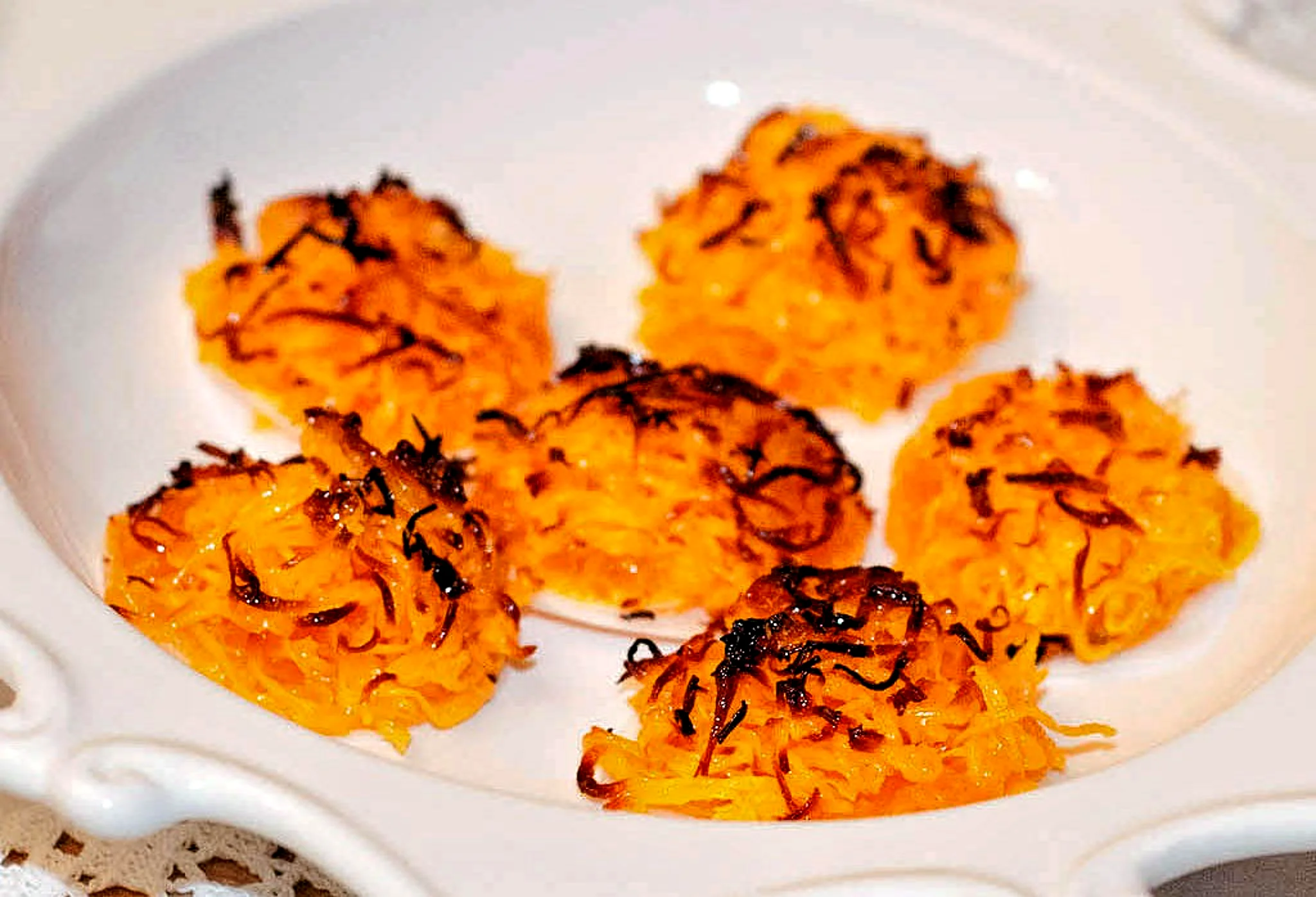
Palha de Abrantes — literally "Abrantes Straw" — is the most iconic sweet of the city and one of the most refined products of Portuguese conventual confectionery. It consists of a soft, rich filling of pure egg yolk and finely ground almond, wrapped in delicate golden threads of fios de ovos (egg-yolk threads) that are then lightly toasted in a very hot oven to develop a thin, crackling surface. The result is intensely sweet, deeply yellow, and unmistakably elegant — a pastry that has officially been classified as a Tradicional Português product by Portugal's national agricultural traditions register (DGADR).
The recipe traces back to one of Abrantes's medieval female convents — most accounts attribute it to the Convento da Graça, which operated in the city between the 14th and 16th centuries. As with many great Portuguese conventual sweets, the origin is practical: the nuns used egg whites to starch their habits and the linen of the convent laundry, leaving an abundance of yolks behind. These yolks were transformed into elaborate sweets following recipes that, in the case of Palha de Abrantes, were kept strictly secret.
According to local tradition, the recipe was first leaked through the washerwomen of Rio de Moinhos, who served the Dominican nuns of the convent and, after gaining their trust, obtained the recipes for several Abrantes specialities including Palha de Abrantes, Tigeladas, and Broas de Mel. The name "palha" (straw) is said to refer to the historic role of Abrantes as a river-port entrepôt where straw transported from the Alentejo was unloaded en route to the stables of Lisbon — the golden threads of the pastry evoking the bundles passing through the city.
Today around half a dozen pastelarias in Abrantes specialise in Palha de Abrantes. The Pastelaria Tágide Gourmet (Chef Fernando Correia, opened 1981) holds the 1st prize for Abrantes confectionery and is the recognised modern master. Confeitaria Palha de Abrantes (Praça Barão da Batalha 18) is the eponymous bakery. Pastelaria Pereira and Pastelaria Guloseima are excellent local alternatives. Typical price: €1.50–€2.50 per slice.
Signature dishes
- Palha de Abrantes (the original — egg yolk + almond + fios de ovos)
- Palha de Abrantes ao corte (sliced from a whole roll)
- Caixa de Palha de Abrantes (box of 6–8 slices for takeaway)
- Palha de Abrantes + bica (the classic Abrantes coffee-break pairing)
- Palha de Abrantes + moscatel (with sweet wine, for a treat)
Highlights
- Officially classified as a Tradicional Português product (DGADR)
- Origin in the medieval Convento da Graça (14th–16th century)
- Made from pure egg yolk, finely ground almond, and golden fios de ovos
- Recipe historically kept secret — leaked via the washerwomen of Rio de Moinhos
- Name links to Abrantes's role as a Tagus river port for Alentejo straw
- Chef Fernando Correia (Pastelaria Tágide Gourmet) is the modern master
- Confeitaria Palha de Abrantes — Praça Barão da Batalha 18 (eponymous bakery)
- Typical price: €1.50–€2.50 per slice; sold whole for special occasions
Dietary options
Frequently asked questions
Where can I buy authentic Palha de Abrantes?
Several historic addresses in Abrantes. The Pastelaria Tágide Gourmet (Chef Fernando Correia) is the modern benchmark — 1st prize for Abrantes confectionery and a national reputation. Confeitaria Palha de Abrantes (Praça Barão da Batalha 18, +351 241 401 873) is the eponymous shop in the historic centre. Pastelaria Pereira (Avenida Mário Soares 274) and Pastelaria Guloseima (Largo Motta Ferraz 11) are excellent neighbourhood alternatives. Avoid generic supermarket versions — quality varies dramatically vs the artisan bakeries.
What does Palha de Abrantes taste like?
Intensely sweet and richly egg-y, with the gentle floral perfume of toasted almond and a thin crackling shell from the oven-toasted fios de ovos threads. Different in profile from a pastel de nata (which is custard-based) or a queijada (which is cheese-based) — Palha de Abrantes is the most concentrated egg-yolk sweet of Portuguese conventual tradition, similar in family to ovos moles de Aveiro or trouxas-de-ovos. Best eaten with espresso or moscatel.
Why is it called "Palha" (straw)?
Two theories. Visually, the fine threads of fios de ovos that wrap the filling resemble bundles of golden straw. Historically, Abrantes was a major Tagus-river entrepôt where straw transported from the Alentejo passed on its way to the stables of Lisbon — the local tradition links the pastry's name to that historic role. Both stories are part of Abrantes's identity.
Is the recipe vegetarian / gluten-free / vegan?
Vegetarian yes — egg yolks, sugar, almond, with some bakeries using a base shell of light pastry (varies). Some versions are gluten-free if no pastry shell is used. Not vegan (heavily egg-based). High in egg cholesterol and sugar — eat as an occasional treat, not a daily pastry.
Can I take Palha de Abrantes home from Portugal?
Yes — most bakeries sell sealed boxes designed for transport (typically 6–8 slices, €10–€18 depending on bakery). They keep 3–5 days at room temperature. The egg-yolk filling is best within 48 hours of baking; the fios de ovos crust holds longer. They survive a flight in carry-on luggage and make popular gifts.
