
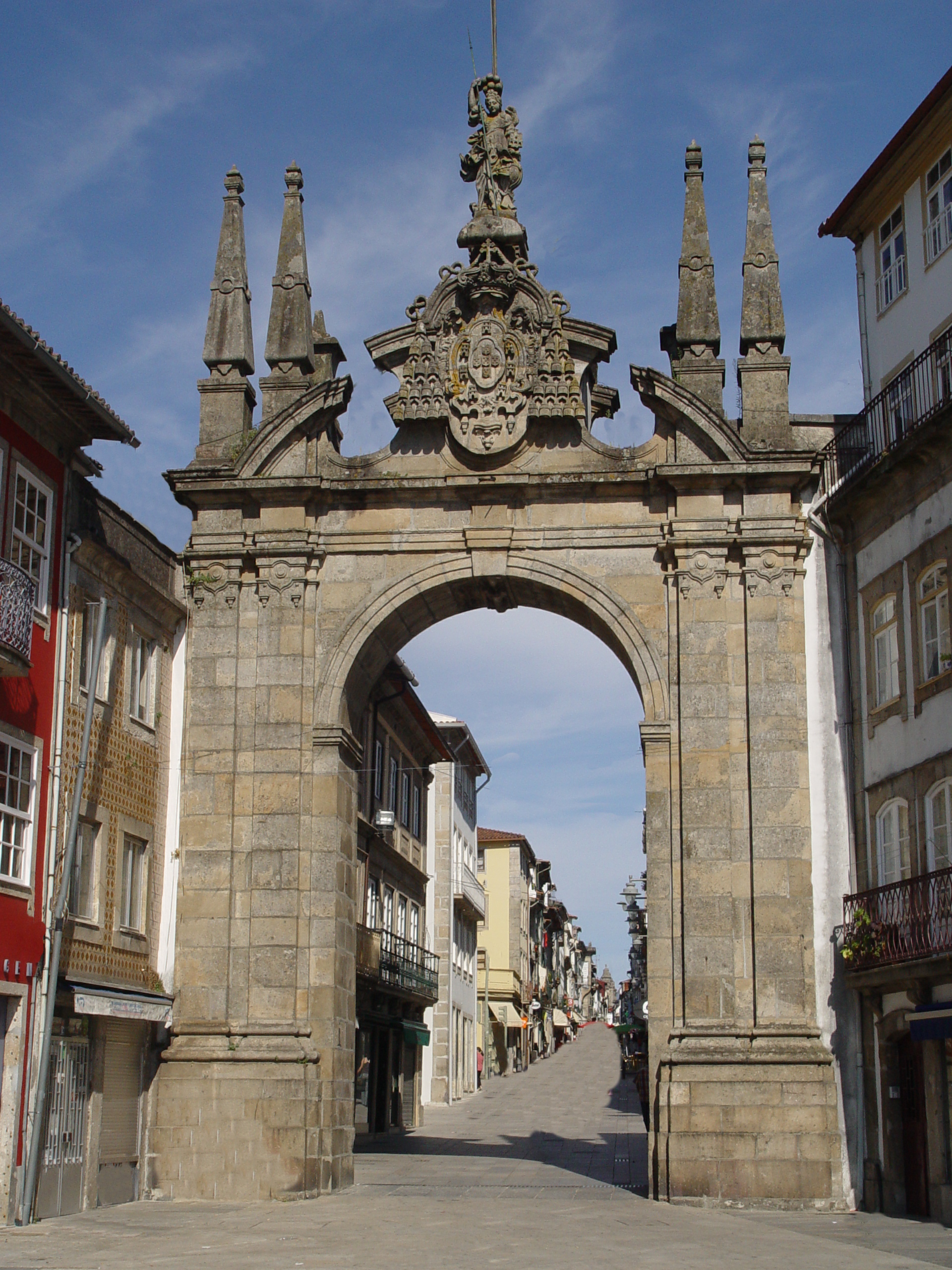
The Arco da Porta Nova is the monumental gateway to the old city of Braga — an eighteenth-century triumphal arch that marks the entrance to the historic centre.
The arch stands on the site of an earlier medieval gate in the city walls. The present structure dates from the late eighteenth century, built in a Baroque and neoclassical manner. It carries different faces on its two sides: looking outward, the coat of arms of the archbishop who ordered it, a display of power; looking inward, towards the city, an image of the Virgin, set there to protect Braga.
For the visitor, the Arco da Porta Nova is the natural threshold to a walk through old Braga: the historic city tour traditionally begins here, passing under the arch and into the network of streets, squares and churches of the centre. It is a handsome and much-photographed landmark, and the symbolic doorway into the heart of the city.
Highlights
- The ceremonial gateway to the old city of Braga
- An eighteenth-century Baroque and neoclassical arch
- On the site of an earlier medieval city gate
- An archbishop's coat of arms facing outward
- An image of the Virgin facing the city, for protection
History & context
The Arco da Porta Nova stands on the site of a medieval gate in the walls of Braga. The present arch dates from the late eighteenth century, built in a Baroque and neoclassical manner under Archbishop Gaspar de Bragança. Its outward face carries the archbishop's coat of arms, while the face towards the city carries an image of the Virgin, set to protect Braga. It marks the ceremonial entrance to the historic centre.
🗓️ Best time to visit
Any time of year; the arch is freely accessible and a natural start to a city walk.
⏱️ Duration
10–15 minutes
♿ Accessibility
Good. The arch is in the level city centre and freely accessible.
Frequently asked questions
What is the Arco da Porta Nova?
It is the eighteenth-century ceremonial gateway to the old city of Braga, marking the entrance to its historic centre.
Why does the arch have two different faces?
Its outward face carries the archbishop's coat of arms; the face towards the city carries an image of the Virgin, to protect Braga.
Where does a walk through old Braga begin?
The historic city tour traditionally begins at the Arco da Porta Nova, passing under the arch into the old streets.