
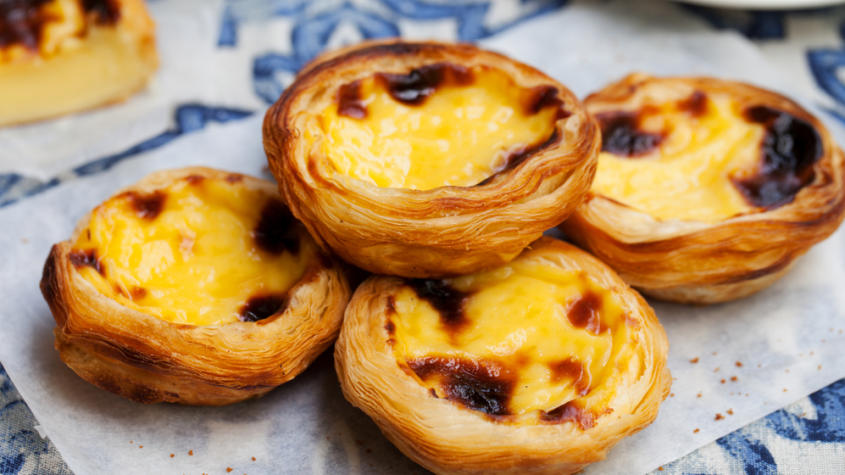
The pastel de nata is Portugal's most famous export — a small, flaky puff-pastry tart filled with creamy egg custard and blistered in scorching ovens until the top is caramelised, almost burnt, while the centre remains soft and warm.
The original recipe was created by monks at the Jerónimos Monastery in Belém before 1820. When religious orders were dissolved in 1834, the monks sold the recipe to a nearby sugar refinery, whose owners opened a small shop in 1837 — what is now Pastéis de Belém. To this day, only three pastry chefs at any given time know the exact original recipe, and the tarts sold there carry a different name: pastéis de Belém. Everything made elsewhere is called pastel de nata.
The technique is what makes them special. The puff pastry is rolled in dozens of layers, the custard is rich with egg yolks and lightly thickened with flour, and the tarts are baked at around 300°C for just a few minutes. The intense heat blisters the surface into dark caramel spots while the pastry shatters into hundreds of crisp layers.
Locals eat them warm, often standing at the counter, with a sprinkle of cinnamon and powdered sugar (which sit in shakers on every counter), paired with an espresso ("bica" in Lisbon, "cimbalino" in Porto). A typical pastel costs €1.20–€1.50 at a neighbourhood pastelaria, €1.50–€2.00 at the famous addresses.
Beyond Belém, the modern benchmark is Manteigaria (with shops in Chiado, Time Out Market, and Rato) — where you can watch the tarts being assembled and pulled from the oven every few minutes.
⭐ Must-try:
The original at Pastéis de Belém (since 1837) — still made from the secret monastery recipe
Signature dishes
- Pastel de Belém (the original, from the 1837 shop in Belém)
- Pastel de nata da Manteigaria (modern benchmark)
- Pastel de nata com canela e açúcar em pó (cinnamon & sugar)
- Pastel de nata e bica (the classic Lisbon café duo)
Highlights
- Original recipe from Jerónimos Monastery, Belém (pre-1820)
- Pastéis de Belém: only 3 chefs know the secret recipe
- Baked at ~300°C for the signature caramelised blistered top
- Dozens of flaky puff-pastry layers; soft warm custard centre
- Best eaten warm — within 20 minutes of leaving the oven
- Sprinkle with cinnamon and powdered sugar (counter shakers)
- Pair with espresso (bica) — Portugal's classic café snack
- Typical price: €1.20–€2.00 each
- Manteigaria is the modern benchmark outside Belém
- Vegetarian (contains dairy and eggs)
Dietary options
✓ Vegetarian
✓ Contains dairy
✓ Contains egg
✓ Contains gluten
✓ Nut-free (most recipes)
Frequently asked questions
What's the difference between pastel de nata and pastel de Belém?
They're essentially the same pastry, but only the original shop in Belém (Pastéis de Belém) can legally call them "pastéis de Belém" — it's a protected name. The recipe at that shop is a closely-guarded secret kept by just three master pastry chefs. Everything made anywhere else is called pastel de nata, and good ones are excellent.
Where can I find the best pastel de nata in Lisbon?
For the original recipe, Pastéis de Belém (queue early, or use the side door for takeaway). For the best modern version, Manteigaria — locations in Chiado, Time Out Market, Príncipe Real, and Rato; you can watch them being made and pulled from the oven every few minutes. Other excellent options include Aloma, Castro, and Fábrica da Nata.
Should I eat pastel de nata warm or cold?
Always warm, ideally within 20 minutes of coming out of the oven. The contrast between the still-flaky shattering pastry and the warm soft custard is essential. Cold pastéis de nata are still nice, but they're not the experience locals know — the pastry softens and the custard thickens.
Is pastel de nata vegetarian or gluten-free?
Vegetarian, yes — it contains dairy and egg yolks. Gluten-free, no — the puff pastry is wheat-based. A few specialist bakeries in Lisbon (e.g. Casa do Pão sem Glúten) offer gluten-free versions, but they're rare and the texture differs.
Can I take pastéis de nata home from Portugal?
They travel poorly fresh — the pastry softens within hours. Many bakeries (including Pastéis de Belém) sell sealed boxes designed for travel and they survive a few days. For the authentic warm experience, eat them in Portugal.