
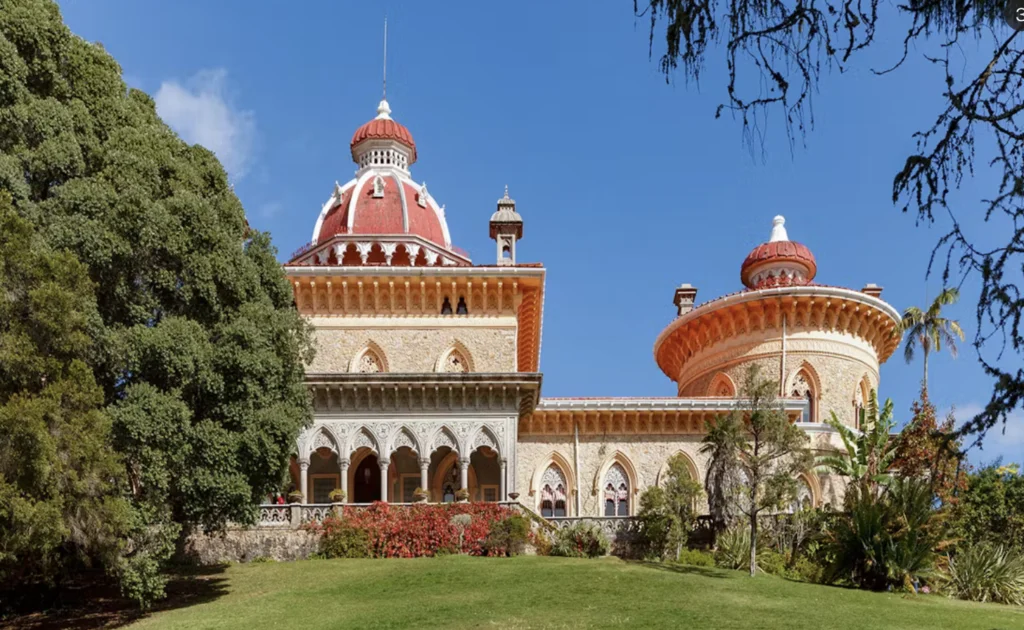
Monserrate Palace (Palácio de Monserrate) is the most beautiful — and most surprising — of Sintra's palaces. While Pena draws the crowds and the photo queues, Monserrate sits 6 km outside the town centre in relative quiet, surrounded by what is widely considered the finest botanical garden in Portugal. The combination of an exotic, openwork stone palace and 30 hectares of meticulously curated grounds makes it many visitors' favourite Sintra experience.
The current palace was built between 1858 and 1865 for Sir Francis Cook, a Victorian English textile magnate who leased and later bought the estate from previous English owners. Cook commissioned the architect James Knowles Jr. — son of the editor of the influential Nineteenth Century journal — to design a residence that fused Gothic Revival, Indian Mughal, and Moorish architectural traditions. The result is unique in Europe: alabaster filigree window screens copied from Mughal palaces in India, Moorish horseshoe arches, Gothic ribbed ceilings, and a long airy gallery painted in palest cream and gold.
The garden is the masterpiece. Cook hired botanist William Stockdale to create a "botanical paradise" with plants from Australia, the Americas, southern Africa, the Himalayas, and East Asia, organised into themed micro-environments: a Mexican garden of cacti, a tropical valley, a rose garden, a fern dell, formal lawns, and a Japanese-style pool. Eucalypts brought from Australia in the 1850s are now among the largest in Europe. Hidden ruins of a Gothic chapel (deliberately built as a romantic folly) sit at one end.
UNESCO inscribed Monserrate in 1995 as part of the Cultural Landscape of Sintra. Plan at least 2 hours — palace and garden together.
Highlights
- Unique fusion of Gothic, Mughal Indian, and Moorish architectural styles
- Alabaster filigree window screens copied from Mughal palaces in India
- 30 hectares of botanical garden — Portugal's finest exotic park
- Plants from Australia, Americas, Himalayas, East Asia, southern Africa
- Built 1858–1865 for English textile magnate Sir Francis Cook
- Gothic chapel ruin — a deliberate romantic folly in the gardens
- UNESCO World Heritage Site (Cultural Landscape of Sintra, 1995)
- Much quieter than Pena Palace — most peaceful visit in Sintra
- 6 km from Sintra Vila — reach by bus 435 or car
History & context
The Monserrate estate has a 400-year history of foreign owners and reinventions. The first villa on the site was built in the late 16th century by a Portuguese family who named it after the Catalan monastery of Montserrat, dedicated to the same Marian devotion. The original villa was destroyed in the 1755 Lisbon earthquake.
In 1789 the ruined estate was rented by Gerard de Visme, a wealthy English merchant trading with Portugal, who built a small neo-Gothic villa on the foundations. After de Visme moved away the property changed hands several times. William Beckford, the eccentric English novelist and aesthete, leased it in 1794 and developed the gardens with Romantic landscaping. Lord Byron stayed nearby in 1809 and famously mentioned Monserrate in his poem "Childe Harold's Pilgrimage."
The transformative owner was Sir Francis Cook (1817–1901), a London-based Anglo-Portuguese textile magnate who leased Monserrate in 1856 and bought it outright shortly after. Cook commissioned architect James Knowles Jr. to design the current palace between 1858 and 1865, drawing inspiration from Indian Mughal palaces (which Cook had not visited but admired through prints), Moorish architecture, and Gothic Revival. The fusion was deliberately exotic and Romantic.
Cook also hired botanist William Stockdale and master gardener James Burt to lay out the 30-hectare garden as a global botanical collection. Plants and seeds were imported from every continent, often via Cook's commercial shipping connections. The estate became a centre of horticultural innovation in the late 19th century, supplying specimens to Kew Gardens in London.
After Cook's death the estate passed through his descendants until 1949, when it was sold to the Portuguese state. UNESCO inscribed Monserrate in 1995 as part of the Cultural Landscape of Sintra. From 2000 onwards the state-owned Parques de Sintra–Monte da Lua undertook a 20-year restoration of both palace and gardens, bringing them back to their 19th-century splendour.
🗓️ Best time to visit
April–June for flowering gardens. Late afternoon for soft light through the stone filigree.
⏱️ Duration
2 hours (palace + gardens)
♿ Accessibility
Partial. Palace ground floor accessible; gardens have steep gravel paths in places.
Frequently asked questions
How do I get to Monserrate Palace from Sintra?
Bus 435 from Sintra train station runs a loop including Quinta da Regaleira, Seteais and Monserrate (€7.60 return, hourly). The bus stops at the Monserrate gate. By car it's a 15-minute drive on the EN247; free parking is available outside the gate. Walking from Sintra Vila is possible (~1 hour each way through forest roads) but most visitors take the bus.
Is Monserrate better than Pena Palace?
They're different experiences. Pena is Portugal's most photographed monument — colourful, dramatic, on a hilltop, very crowded. Monserrate is quieter, more elegant, with the country's best gardens and a unique architectural style. If you can only choose one, Pena offers the iconic views; Monserrate offers a more peaceful, atmospheric visit. Many regular visitors say Monserrate is the most beautiful palace in Sintra.
How long should I plan for the visit?
2 hours minimum — about 45 minutes inside the palace and 75+ minutes wandering the gardens. Garden enthusiasts could easily spend a half-day. The botanical layout is large enough to feel like a forest park; the path system is well-marked but allow time to get pleasantly lost.
Is Monserrate accessible for wheelchairs?
Partially. The palace ground floor is wheelchair-accessible (the upper floors are not visitor areas anyway). The gardens have some accessible paths near the palace, but the broader grounds involve steep slopes, gravel paths, and stairs. The Mexican garden and the area around the main palace are the most accessible sections.
When is the best time to visit Monserrate?
Spring (April–June) when the camellias, azaleas and the rose garden are at their peak. Early autumn (September–October) is also excellent for the gardens. Pleasant year-round because most paths are shaded by the canopy. Avoid August midday — the small parking area fills up. Late afternoon any season offers the best light through the palace's stone filigree.