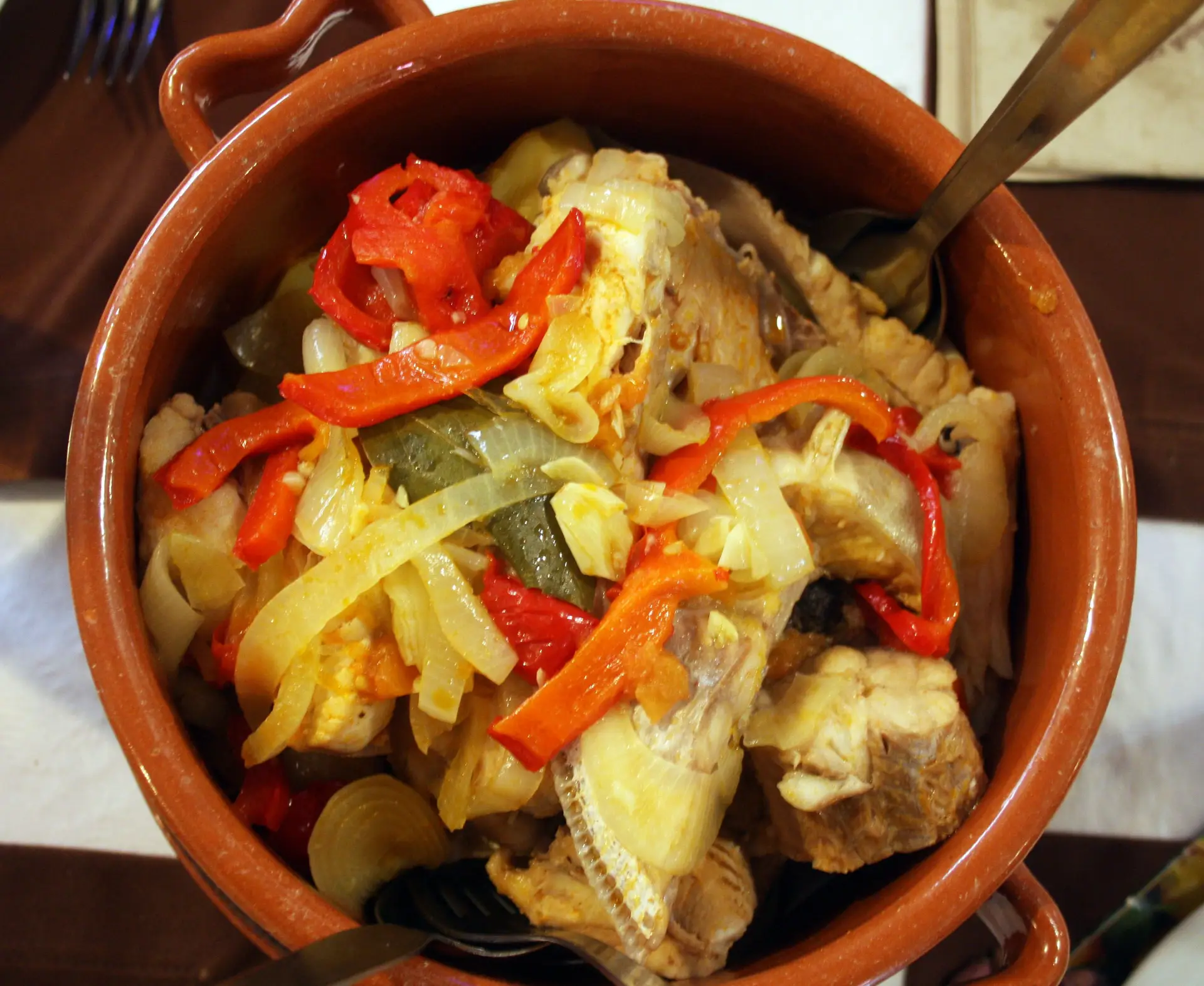
Caldeirada de Peixe — Figueira da Foz

Caldeirada de Peixe

Fish stew €€ 📍 Coastal Figueira da Foz & Buarcos Communal dish — typically served in the cooking pot at the centre of the table, with bread and broth on the side

Caldeirada de peixe is the dish that defines the Portuguese coastal kitchen, and Figueira da Foz has its own way of making it. The name comes from caldeira — the pot itself — and the dish was born on fishing boats, where one crew member was elected to caldeirar, cooking for the rest using whatever the day's catch had left aside as "lesser" fish, not destined for sale.
The Figueira version follows the standard layered method: thinly sliced potato, onion, tomato, peppers, garlic, bay leaf and parsley are arranged in a heavy pot, generously dressed with olive oil and white wine, and then topped with the fish. The pot is covered and left over low heat for around thirty minutes, never stirred — the layers cook together by themselves, and the broth that forms at the bottom is the soul of the dish.
Where the Figueira version departs from neighbours like Setúbal or Nazaré is in the choice of fish and the finishing step. The local preference leans on petinga — small sardines — seasoned simply with salt and pepper, cooked until the flesh comes away from the bones. Once the dish is ready, broa (Portuguese corn bread) is crumbled into a separate clay tureen and the broth is ladled over it before serving. The diner alternates between the soaked bread and the fish itself.
A separate, distinct tradition exists across the river in Lavos: caldeirada de enguias, made with eels from the Mondego marshes, layered with onion and seasoned with sal de unto — pork lard salt — instead of white wine.

Signature dishes

  • Caldeirada de Petinga (Figueira da Foz)
  • Caldeirada de Enguias à moda de Armazéns de Lavos
  • Caldeirada à Fragateira (Tagus variant)

Highlights

  • Layered fish stew cooked without stirring, in the traditional Portuguese fishermen's style
  • The Figueira version is traditionally made with petinga — small sardines from the local catch
  • Finished with crumbled broa (corn bread) in a separate tureen, soaked with the broth
  • A distinct variant from Lavos uses Mondego eels and sal de unto (pork lard salt)
  • Best eaten in late spring and summer, when local sardine and bivalve fishing peaks

Dietary options

✓ Contains fish, ✓ Gluten-free without broa ✓ Dairy-free ✓ Not suitable for vegetarians

Frequently asked questions

How is caldeirada different from arroz de marisco?

Caldeirada is a layered fish stew with potato, onion and peppers — no rice. The broth forms at the bottom of the pot and is soaked up with bread. Arroz de marisco is a rice dish bound by a tomato-rich seafood broth. They share ingredients but have completely different textures and roles.

Why is it never stirred?

The layered cooking method allows each ingredient to release its flavour and moisture slowly, building up the broth at the bottom of the pot. Stirring breaks the layers, mixes the textures and dilutes the structure that defines the dish.

What fish goes into a Figueira caldeirada?

Traditionally petinga — small sardines — is the marker of the local version. Other versions use conger eel, monkfish, ray and pollock; the rule is to combine three or more kinds of fresh fish from the day's catch.

What is broa, and why is it served with caldeirada?

Broa is the dense Portuguese corn bread made with maize flour. In the Figueira version, it is crumbled into a separate clay tureen and the cooking broth is ladled over it, creating a kind of bread soup eaten alongside the fish.

When is the best season to eat caldeirada?

Year-round, but it is at its best from late spring through early autumn, when Atlantic sardine fishing and the local bivalve supply are at their peak. Petinga itself is most abundant from May to September.